30+
Years
Exclusive Restaurant HR Experience
500+
Restaurants
Protected Across the U.S.
$20M+
In Potential Fines
Avoided for Our Clients
50+
Restaurant Chains
Served Nationwide
100+
DOL Audits
Successfully Managed

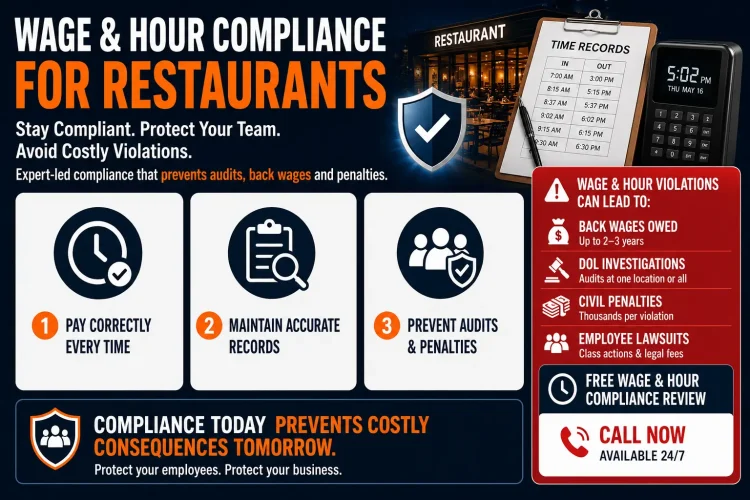
The restaurant industry generates more DOL wage enforcement actions than any other sector in the U.S. Expert-led compliance for restaurant chains — tip credit, overtime, timekeeping, multi-state payroll, and DOL audit defense.
Wage and hour compliance for restaurants isn’t a back-office concern — it’s the single largest source of DOL enforcement liability in the food service industry. In 2024, the U.S. Department of Labor recovered more than $274 million in back wages from food service establishments. The restaurant industry has ranked as the most investigated sector for wage and hour violations for over a decade.
For restaurant chains operating with tipped employees, variable schedules, split shifts, and managers making daily pay decisions across multiple locations, wage and hour exposure builds quietly — until it doesn’t. And when enforcement begins, it’s rarely a single violation. Investigators review payroll retroactively across every pay period, every employee, every location.
Senior HR specialists · Wage and hour findings in 48 hours · No obligation
100% Confidential. All reviews conducted under NDA.
30+
Years
Exclusive Restaurant HR Experience
500+
Restaurants
Protected Across the U.S.
$20M+
In Potential Fines
Avoided for Our Clients
50+
Restaurant Chains
Served Nationwide
100+
DOL Audits
Successfully Managed
Senior HR specialists · Wage and hour findings in 48 hours · No obligation
100% Confidential. All reviews conducted under NDA.
Wage and hour compliance governs how restaurants pay employees, track hours worked, calculate overtime, and apply tip-related rules. Unlike many industries, restaurants operate with tipped employees, variable schedules, split shifts, and high turnover — conditions that significantly increase exposure to compliance errors.
Over the past decade, enforcement activity by the Department of Labor and state agencies has intensified. The DOL’s food service enforcement program has recovered over $1.5 billion in back wages over the past decade — an average of $150 million annually.
Most violations are not intentional. They typically arise from misunderstood regulations, inconsistent processes across locations, limited manager training, and outdated or undocumented pay practices. Without proactive oversight, these gaps accumulate quietly until an audit, employee complaint, or lawsuit exposes them — often resulting in significant financial and operational disruption for restaurant operators.
Wage and hour compliance failures in restaurants are rarely intentional — but they are among the most expensive and disruptive risks operators face.
Restaurants rely heavily on tip credits, pooled gratuities, and blended pay rates. These rules are highly technical, and a single error — such as including an ineligible role in a tip pool — can invalidate the entire tip credit and trigger retroactive wage liability across multiple pay periods and locations.
Restaurants with tipped employees face additional exposure when tip pooling and tip credit rules are applied incorrectly, creating compounded wage and hour liability.
Frequent hiring increases the likelihood of missing records, incomplete notices, and inconsistent classifications, all of which raise red flags during audits and significantly increase the scope and duration of investigations.
Scheduling approvals, break practices, time edits, and tip handling are often managed at the supervisor level, where lack of legal training, standardized procedures, and oversight leads to unintentional violations.
These factors explain why proactive wage and hour compliance is essential for restaurant operators — not after an audit, but before enforcement begins.
See the complete list of essential labor compliance rules for restaurants
Errors occur when restaurants fail to calculate overtime correctly for employees with multiple roles, blended pay rates, or tipped wages. These miscalculations often go unnoticed until an DOL audit reviews payroll retroactively across multiple pay periods and roles.
Unpaid prep time, cleanup duties, interrupted breaks, or post-shift tasks frequently result in off-the-clock violations. These practices are heavily scrutinized during wage and hour investigations and frequently result in back-wage assessments.
Improperly classifying employees as exempt from overtime — particularly managers — can result in significant back-wage liability and personal liability exposure for ownership.
Failing to meet tip credit requirements or provide proper notice invalidates the credit entirely, exposing restaurants to full minimum wage liability for all affected employees.
Including managers or supervisors in tip pools is one of the most common triggers for collective lawsuits and Department of Labor enforcement actions.
Missing or inaccurate payroll and time records significantly weaken any compliance defense and limit an employer’s ability to contest findings during audits.
Most restaurants experience more than one of these violations at the same time — often without realizing the cumulative exposure until enforcement begins.
See how straight-time overtime errors cost an IHOP franchise $95K
Most restaurant chains have at least 3 of these violations active right now — and don’t know it until the DOL investigation begins.
Timekeeping is where most restaurant wage violations begin. The DOL doesn’t need to prove intent — it needs to show that hours worked were not paid. Inaccurate, missing, or manipulated timekeeping records are the most common starting point for wage and hour investigations in food service.
Under the FLSA, restaurant employers must maintain accurate records of: hours worked each day and total hours each workweek, regular hourly pay rate, total straight-time and overtime earnings, total wages paid each pay period, and any deductions made from wages. These records must be retained for at least 2 years and be readily available for DOL inspection.
For restaurants taking a tip credit, timekeeping must separately track time spent on tipped duties versus non-tipped duties (the 80/20 rule). When a tipped employee spends more than 20% of their shift on non-tipped work — cleaning, rolling silverware, restocking — those hours cannot be paid at the tipped minimum wage. Without time-separated records, the DOL will assume the tip credit is invalid for all hours worked.
The 80/20 rule — formally the “dual jobs” rule — requires that employers can only take the tip credit for time a tipped employee spends on work that directly supports tip-producing activities. If more than 20% of an employee’s shift is spent on non-tipped duties, the employer must pay full minimum wage for that time.
Examples of non-tipped duties that trigger the 80/20 rule:
The DOL consistently cites 80/20 violations as among the most common findings in restaurant wage audits. Multi-location chains that apply the same tip credit rate to all hours — without tracking non-tipped time — are exposed to retroactive liability for every affected employee across every pay period reviewed.
Restaurant chains operating across multiple states face layered compliance complexity — each state imposes requirements on top of federal FLSA minimums. Getting one state wrong doesn’t just create liability in that state; it signals to investigators that your compliance infrastructure lacks the oversight to manage multiple jurisdictions.
These are the markets where restaurant chains most commonly face multi-state compliance exposure:
DC eliminated the tip credit entirely as of May 2023. All tipped employees must receive DC’s full minimum wage ($17.50/hr in 2025) regardless of tips received. Restaurant groups operating simultaneously in DC, Maryland, and Virginia must maintain three separate payroll configurations — the DC-MD-VA corridor is the most common source of multi-state wage violations among East Coast chains.
No tip credit. Minimum wage $16.50/hr statewide ($20/hr for fast food chains under AB 1228 as of April 2024). California also imposes daily overtime — time-and-a-half after 8 hours in a single day, double time after 12 hours. Federal FLSA only requires weekly overtime (over 40 hours). Chains expanding to California must restructure their payroll entirely before opening the first location.
Tip credit of $10.00/hr applies for NYC hospitality workers (tipped minimum $10.00/hr). Different rates apply outside NYC. New York City’s minimum wage ($16.50/hr) differs from upstate rates ($15.50/hr). NYC also has separate industry wage orders covering restaurant workers that impose additional requirements beyond state law.
Chicago’s tipped minimum wage ($9.48/hr in 2025) exceeds Illinois state rate ($8.40/hr). Chains with locations both inside and outside Chicago must apply different payroll rates by location. Chicago’s annual minimum wage increases occur on July 1, not January 1 like most states — a common source of missed updates for multi-location operators.
Chicago updates July 1, 2026 — see our complete Chicago restaurant compliance 2026 guide
Follows federal FLSA tip credit ($2.13/hr tipped minimum). No state income tax simplifies payroll, but DOL’s Southwest regional office conducts aggressive enforcement of tip pool documentation and overtime calculations. Texas chains with blended-rate employees across multiple roles face elevated audit risk.
Both states have tipped minimums above the federal rate and different overtime thresholds. Virginia’s tipped minimum is $2.13/hr but the state minimum wage has increased annually — the gap between the tipped rate and state minimum requires careful tracking. Maryland’s tipped minimum was $3.63/hr in 2024 with scheduled annual increases.
Oregon does not permit a tip credit. All tipped employees receive the full state minimum wage regardless of tips received. Oregon operates a two-tier minimum wage system — Portland Metro employers pay $15.95/hr while non-urban employers pay $14.70/hr. Restaurant chains with locations in both Portland and other Oregon cities must configure two separate minimum wage rates within the same state. Chains expanding from tip-credit states must fully restructure tipped employee payroll before opening any Oregon location. Oregon’s minimum wage updates July 1 — not January 1.
Washington State does not permit a tip credit. The state minimum wage is $16.28/hr for all employees regardless of tips received. A critical distinction for Washington operations: automatic gratuities and mandatory service charges are not tips under Washington law — they are wages subject to full payroll tax treatment and must be included in overtime calculations. Chains that apply service charges in Washington without treating them as wages create simultaneous overtime and tax compliance exposure across every affected pay period.
These are documented outcomes from DOL Wage and Hour Division enforcement actions in the restaurant industry. They are not outliers — they represent the standard trajectory when compliance gaps go unaddressed:
These outcomes follow a consistent pattern: minor violations accumulate across pay periods and locations, eventually surfacing during a Restaurant HR Compliance Audit—when corrective action is no longer cost-effective.
Wage and hour investigations frequently expand into broader reviews of I-9 and employee documentation compliance, especially in multi-location restaurant operations.
Workforce policies outlined in the restaurant employee handbook compliance must align with wage execution practices
These outcomes start with the same gaps most restaurant chains have today — and don’t know about.
48-hour turnaround · Restaurant chains with 3+ locations · Confidential
Investigators follow structured processes designed to identify systemic issues rather than isolated mistakes. Even minor errors become serious when repeated consistently across pay periods, employees, or locations — often resulting in expanded audit scope and increased financial exposure.
Preparing for a DOL audit — or already received an inquiry?
Immediate support available · English & Spanish
Beyond fines and back wages, wage and hour non-compliance exposes restaurants to legal fees, operational disruption, reputational damage, and increased regulatory scrutiny — often diverting leadership focus away from growth and operations.
For restaurant chains, wage and hour exposure often ranges from $20,000 to $200,000 per location— with significantly higher cumulative risk for multi-state operations.
In multi-location environments, even small compliance gaps can multiply rapidly — turning manageable issues into enterprise-level exposure.
Our HR compliance services help prevent these outcomes by proactively identifying risks and ensuring ongoing compliance across all locations.
DOL investigations are one enforcement path. The other — increasingly common for multi-location restaurant chains — is private litigation. Wage and hour class actions filed by current or former employees do not require a DOL investigation to trigger, and they carry the same back-wage exposure with the addition of plaintiffs’ attorney fees. These are the five payroll errors most frequently cited in restaurant wage and hour lawsuits:
When an overtime calculation error is embedded in payroll software configuration — for example, calculating overtime on the cash wage rather than the regular rate of pay inclusive of tips — the error replicates identically across every affected employee for every pay period the configuration exists. A single configuration error in a 10-location chain can generate a class-wide back-wage claim covering hundreds of employees across two to three years.
A tip credit is invalidated for an entire pay period if any one of its requirements fails — missing written notice, manager participation in the tip pool, or cash wage falling below the applicable tipped minimum. When a plaintiff’s attorney establishes that the tip credit was systematically invalid, every hour worked by every tipped employee during the affected period becomes a minimum wage violation. For a chain with 50 tipped employees per location, tip credit invalidation across 10 locations for a two-year period can generate seven-figure back-wage liability before liquidated damages.
Payroll systems that automatically deduct 30-minute meal breaks from every shift — regardless of whether the break was actually taken — are among the most common sources of wage and hour class actions in the restaurant industry. If employees routinely work through breaks without the employer adjusting the deduction, every affected shift generates an unpaid time claim. The systematic nature of the auto-deduct means every employee on the same payroll configuration is a potential class member.
Pre-shift setup, post-shift cleaning, and mandatory meetings held outside clocked time are the most frequently cited off-the-clock violations in restaurant litigation. When a manager instructs employees to complete tasks before clocking in or after clocking out — even informally — and that practice is consistent across locations, it becomes a class-wide claim. The employer’s liability is calculated on every minute of uncompensated time across every affected employee for the entire statute of limitations period.
Restaurant chains that classify assistant managers or shift leaders as exempt from overtime — without meeting the FLSA’s salary basis and duties tests — expose themselves to back-wage claims covering every overtime hour worked by every misclassified manager. Because the same job title and compensation structure typically applies across all locations, a single misclassification affects the entire management tier chain-wide.
Each of these errors shares a structural characteristic: they are systematic, they replicate across every affected employee, and they are invisible until litigation or enforcement makes them visible. The most effective defense against wage and hour class actions is a proactive compliance audit that identifies systematic errors before a plaintiff’s attorney does.
See how myHRCD identifies and corrects systematic payroll errors across all locations →
Most restaurant chains have at least 3 of the following violations active right now — and don’t know it until the DOL investigation begins. Use this checklist to assess your current wage and hour compliance status across all locations.
☐ All hours worked — including pre/post-shift tasks — are recorded and paid
☐ Overtime is calculated correctly across all roles, blended rates, and tipped wages
☐ Meal breaks are only deducted when employees are fully relieved of all duties
+ 12 additional compliance checks covering tip credit notices, 80/20 tracking, manager time edits, employee classifications, payroll record retention, and state-specific wage configurations.
Enter your information to receive the full checklist with location-by-location audit tracker, updated for 2026 DOL enforcement priorities.
Missing items on this checklist? Those gaps are fixable before the DOL finds them.
Already discovered a violation? See the self-correction process before DOL enforcement begins →
La mayoría de las cadenas que completan esta lista de verificación identifican al menos una infracción sistemática. El siguiente paso no es una consulta legal, sino una evaluación de cumplimiento que le indicará exactamente cuánto debe, en qué ubicaciones y cuánto costará corregirlo antes de que lo haga el Departamento de Trabajo.
myHRCD proporciona resultados de cumplimiento de salarios y horarios en todas sus ubicaciones en 48 horas.
Most HR firms conduct a one-time wage and hour review and hand you a report. MYHRCD manages wage and hour compliance as an ongoing function — tracking regulatory changes, monitoring payroll practices, and keeping your chain protected as you scale and expand into new states.
MYHRCD’s wage and hour compliance management is designed for restaurant chains operating 3 to 50+ locations with tipped employees, variable schedules, and multi-state payroll complexity. If your chain operates in 2+ states, or if you’ve had a DOL inquiry in the past, managed compliance is not optional — it’s the most cost-effective risk management decision you can make.
The five most common payroll violations that trigger DOL investigations in restaurants: (1) Not paying for pre- and post-shift work like setup, breakdown, and mandatory meetings. (2) Auto-deducting meal breaks when employees never fully stop working. (3) Including managers or supervisors in tip pools, which invalidates the tip credit retroactively for all affected pay periods. (4) Applying the tip credit without providing the required written notice to each tipped employee individually. (5) Calculating overtime on the tipped wage rate instead of the full minimum wage rate — overtime for tipped employees must be based on the full applicable minimum wage, not the $2.13 tipped minimum.
The core federal requirements under the FLSA for restaurants are: pay all employees at least the applicable federal or state minimum wage; pay overtime at 1.5x the regular rate for all hours over 40 per week; maintain accurate time records for every employee; provide required written notice before taking a tip credit; limit tip pools to non-managerial tipped employees; and retain payroll records for a minimum of 2 years. State law often imposes higher standards — minimum wage, overtime, and break requirements vary significantly across states.
Most DOL restaurant investigations are triggered by employee complaints filed through the Wage and Hour Division’s complaint portal — any current or former employee can file anonymously. Other triggers include: tip credit misapplication detected through payroll data, referrals from state labor agencies, industry-wide enforcement initiatives targeting food service, and prior violation history at the same employer. Restaurants that have been investigated before are significantly more likely to be re-audited, especially if they did not address the root causes of the original violations.
The standard statute of limitations is 2 years for non-willful violations. For willful violations — where the employer knew or should have known they were violating the law — the DOL can investigate up to 3 years back. In practice, DOL investigators routinely request the full 3 years of payroll records and make willfulness determinations based on documented patterns. For a restaurant chain with 10 locations and 50 employees each, a 3-year retroactive back-wage assessment can exceed $1 million even for relatively minor systematic violations.
The 80/20 rule requires that when a tipped employee spends more than 20% of their shift on non-tipped duties — cleaning, rolling silverware, restocking condiments — the employer cannot take the tip credit for those hours. Those hours must be paid at the full applicable minimum wage. This rule applies in every state that allows a tip credit and is consistently cited as one of the most common violations in DOL restaurant audits. Without separate time tracking for tipped and non-tipped duties, the restaurant cannot demonstrate compliance.
Under federal FLSA, employers can pay tipped employees as little as $2.13/hr if tips bring total compensation to at least $7.25/hr. However, overtime for a tipped employee must be calculated based on the full minimum wage — not the tipped wage. Overtime for a tipped employee is 1.5x $7.25 = $10.88/hr, minus the tip credit of up to $5.12/hr, not 1.5x $2.13. Restaurants that calculate overtime on the tipped rate systematically underpay overtime and accumulate back-wage liability across every affected pay period.
Preparation includes: maintaining accurate timekeeping records for at least 3 years (not just the required 2), documenting the required tip credit notice given individually to each tipped employee, conducting an internal payroll audit to identify and correct violations before investigators do, training managers on their wage and hour obligations and documenting that training, and having an HR compliance partner who understands the DOL’s restaurant enforcement process and can manage the response. Restaurants that engage compliance specialists before an investigation consistently achieve significantly better outcomes than those responding without expert guidance.
A non-willful violation carries a 2-year lookback period and back wages only. A willful violation — where the employer knew or should have known they were violating the law — carries a 3-year lookback and doubles the back-wage liability through liquidated damages. DOL investigators determine willfulness by looking for patterns: identical violations across multiple locations, prior investigation history, absence of documented manager training, and the length of time the violation persisted. For a restaurant chain with 10 locations and 50 tipped employees per location, the difference between non-willful and willful classification on a tip credit violation can exceed $800,000 in additional exposure. Documented compliance systems — manager training records, written tip credit notices, timekeeping audit logs — are the most effective defense against willfulness findings.
Our wage and hour compliance specialists review your current payroll practices across all locations and deliver a clear findings report within 48 hours — identifying your highest-risk gaps before the DOL does.
No obligation. No sales pitch. Just the information you need to make a decision.
Senior specialists review your payroll practices and deliver findings in 48 hours. No sales call required until you’ve seen the results.
Or call us: +1 (203) 675-6796 English · +1 (757) 652-6662 Español
✓ Restaurant chains with 3–50+ locations · ✓ Results in 48 hours · ✓ Senior specialists · ✓ Confidential · ✓ No obligation