30+
Years
Exclusive Restaurant HR Experience
500+
Restaurants
Protected Across the U.S.
$20M+
In Potential Fines
Avoided for Our Clients
50+
Restaurant Chains
Served Nationwide
100+
DOL Audits
Successfully Managed

On July 1, 2026, Chicago’s standard minimum wage increased from $16.60 to $17.05 per hour and the tipped cash wage increased from $12.62 to $12.96 per hour. These rates are now in effect. Under the One Fair Wage Compromise Ordinance passed May 20, 2026, the tip credit remains at 24% — the next scheduled reduction is July 1, 2027.
Restaurant chains that have not updated payroll configurations, issued new written tip credit notices, and updated manager training are generating retroactive back-wage liability for every tipped employee from the first underpaid pay period after July 1.
If your Chicago locations missed the July 1 update — or if you are not certain whether your payroll was correctly configured before the first post-July 1 pay period — myHRCD calculates your exposure and corrects it before enforcement begins.
July 1 Has Passed. Is Your Chicago Payroll Configured Correctly?
+1 (203) 675-6796 English · +1 (757) 652-6662 Español
Senior specialists · 48-hour findings · Available immediately for Chicago operators
30+
Years
Exclusive Restaurant HR Experience
500+
Restaurants
Protected Across the U.S.
$20M+
In Potential Fines
Avoided for Our Clients
50+
Restaurant Chains
Served Nationwide
100+
DOL Audits
Successfully Managed
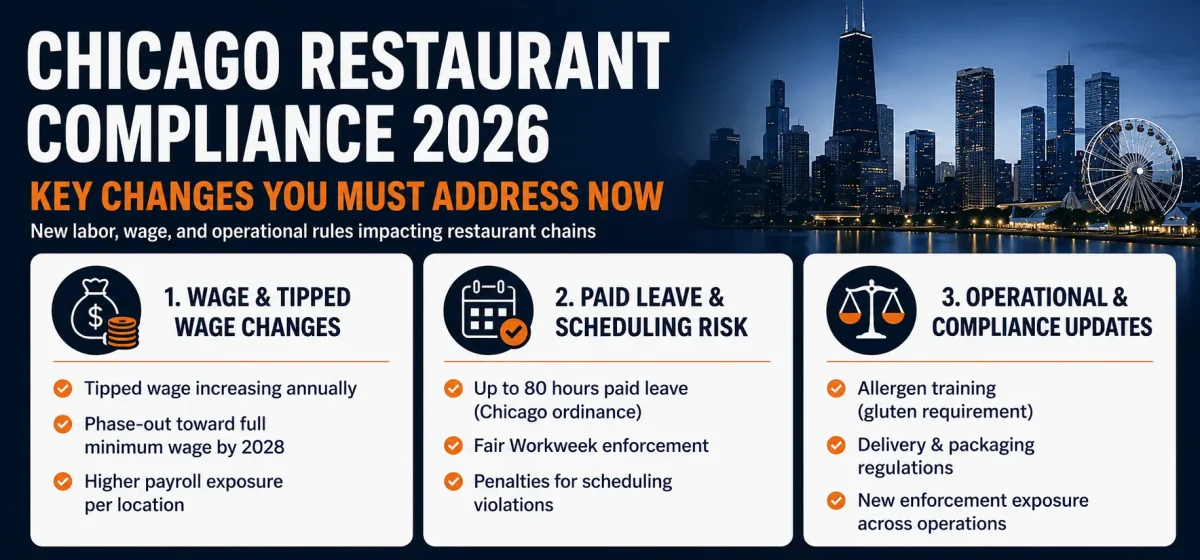
If your Chicago payroll wasn’t updated before July 1, back-wage liability is accruing for every affected employee from the first underpaid pay period. myHRCD calculates your exact exposure and corrects it before enforcement begins — findings in 48 hours, documented for non-willful classification.
Chicago’s standard minimum wage increased to $17.05 per hour for employers with 4 or more employees effective July 1, 2026 — an increase of $0.45 from the previous rate of $16.60. This rate applies to all non-tipped employees. It also serves as the base from which the tip credit percentage is calculated. The increase was calculated at 2.5% of the Consumer Price Index per the methodology in MCC 6-105-020(b)(1)(C).
Required action: If payroll configurations were not updated to $17.05/hr before the first pay period after July 1, back-wage liability is accruing for every non-tipped employee paid below that rate. myHRCD calculates the exact exposure and corrects it. See self-correction before DOL enforcement begins
Verify current rates for all your states in our restaurant minimum wage by state 2026 guide
The tipped cash wage in Chicago increased from $12.62 to $12.96 per hour effective July 1, 2026. The tip credit — the difference between the cash wage and the full minimum wage — remains at 24% of the standard minimum wage under the One Fair Wage Compromise Ordinance approved by the Chicago City Council on May 20, 2026. The tip credit is $4.09 per hour ($17.05 × 24% = $4.09, rounded). The employer must make up the difference if a tipped employee’s cash wages plus tips do not total at least $17.05 per hour in any workweek.
Required action: Update payroll configurations for all tipped employees at Chicago locations to $12.96/hr. Update written tip credit notices per employee — the notice must reflect the new cash wage of $12.96 and the full minimum wage of $17.05. An outdated tip credit notice invalidates the tip credit for each employee who did not receive an updated notice before July 1.
Every tipped employee at every Chicago location must have received a new written tip credit notice reflecting the July 1 rates. The notice must state: the new cash wage of $12.96/hr, the tip credit amount of $4.09/hr claimed, that tips must bring the employee to at least $17.05/hr per workweek, and that the employee retains all tips unless a valid tip pool is in place. This notice must be provided per employee individually — a general posting does not satisfy this requirement. If any tipped employee did not receive an updated notice before the first post-July 1 paycheck, the tip credit is invalid for that employee for every pay period in which the outdated notice was in effect.
See our wage and hour compliance for restaurants guide for overtime calculation examples with the new rates
Effective July 1, 2026, the Illinois Interchange Fee Prohibition Act (IFPA) prohibits financial institutions from charging interchange fees on the portion of a transaction attributable to gratuity. Because employers are no longer being charged credit card processing fees on tip amounts, employers should no longer deduct processing fees from employee tips at Illinois locations. This law is currently subject to legal challenges from national banks — consult with legal counsel on the current enforcement status before updating your policy.
Effective July 1, 2026, the Chicago Fair Workweek Ordinance updated its compensation thresholds. The ordinance covers employees who earn at or below $33.85/hour or $64,945.55/year and work in covered industries including restaurants. For restaurant chains, the ordinance applies to employers with 100 or more employees globally — and 250 employees with 30 or more locations for restaurant groups specifically.
The Fair Workweek Ordinance is a predictive scheduling law that requires covered employers to provide advance notice of schedules, pay premium compensation when schedules change unexpectedly, and offer additional hours to existing part-time employees before hiring new workers. Starting July 1, 2026, covered employees can enforce their rights via private right of action — meaning individual employees can sue directly without filing a city complaint first.
Restaurant chains meeting the 250 employees / 30 locations threshold must verify their scheduling practices comply with the ordinance’s advance notice and premium pay requirements at all Chicago locations.
The Chicago City Council approved the One Fair Wage Compromise Ordinance on May 20, 2026, modifying the original phase-out schedule. The tip credit remains at 24% through July 2027 — the accelerated reductions originally scheduled for 2026 were paused. Updated schedule:
The May 2026 compromise extended the timeline for full elimination by one year — tip credit elimination now reaches zero on July 1, 2029, not July 1, 2028 as originally scheduled. Chicago restaurant chains should begin planning now for a 2029 compensation model that does not rely on the tip credit.
The July 1, 2026 increase is confirmed. There is no pending legislation that can realistically stop it before the effective date. The committee amendment faces significant political headwinds given the mayor’s three successful vetoes on this issue. Chicago restaurant operators should plan for July 1 as a firm deadline — not a contingency.
Chicago is one of the most aggressive markets for restaurant labor compliance enforcement in the country. The One Fair Wage ordinance adds a layer of city-level compliance obligations on top of Illinois state law and federal FLSA requirements. Chains with Chicago locations must maintain separate payroll configurations for those locations — Illinois state law ($15.00/hr, tip credit $9.00/hr) does not apply within Chicago city limits. Cook County rates ($14.05/hr) also do not apply within Chicago city limits. Chicago’s higher rate always prevails.
The Illinois Restaurant Association cited approximately 500 Chicago restaurant closures in the first half of 2025 in its lobbying against the phase-out. For chains that are still operating in Chicago, proactive compliance management is the difference between absorbing the labor cost increase as a planned operational expense and facing retroactive back-wage liability on top of the already increased labor costs.
See how a restaurant HR compliance consultant manages these updates across all your locations
How many items on this checklist are incomplete at your Chicago locations?
+1 (203) 675-6796 English · +1 (757) 652-6662 Español · Immediate availability
Every Chicago restaurant chain should have completed these items before the first pay period after July 1, 2026. If any item is still incomplete, back-wage liability is accruing from the first underpaid pay period. The DOL’s retroactive lookback is 2-3 years — each pay period without correction adds exposure.
If any item on this checklist is not complete before July 1, your Chicago restaurant locations are generating back-wage liability from the first underpaid pay period. The DOL’s retroactive look-back period is 2-3 years — a missed July 1 update compounds every pay period until corrected.
See the complete essential labor compliance rules for restaurants for all jurisdictions
If Your Chain Missed Any Item on This Checklist
Back-wage liability from a missed July 1 update compounds every pay period until corrected. The difference between correcting now versus waiting until a DOL investigation begins is the difference between non-willful classification (2-year lookback, back wages only) and willful classification (3-year lookback, double liability).
myHRCD calculates your exact Chicago exposure — affected employees, affected pay periods, total back-wage amount — and implements the correction in a format that documents good-faith compliance effort for non-willful classification.
MYHRCD’s senior specialists review your Chicago payroll configuration, tip credit notices, and documentation — findings in 48 hours. No obligation.
+1 (203) 675-6796 English · +1 (757) 652-6662 Español
✓ 30+ Years Exclusive Restaurant Experience ✓ Chicago specialist · Available immediately ✓ No Obligation
Chicago’s tipped cash wage increased to $12.96 per hour on July 1, 2026, up from $12.62. Under the One Fair Wage Compromise Ordinance approved by the Chicago City Council on May 20, 2026, the tip credit remains at 24% of the standard minimum wage — the accelerated reductions originally scheduled for July 2026 were paused. The tip credit amount is $4.09 per hour ($17.05 × 24%, rounded). The standard minimum wage for non-tipped employees also increased to $17.05 per hour on July 1, 2026. If a tipped employee’s cash wages plus tips do not total at least $17.05 per hour in any workweek, the employer must pay the difference. Both rates apply to employers with 4 or more employees within Chicago city limits.
No. The Chicago City Council voted on March 18, 2026 to freeze the phase-out, but Mayor Brandon Johnson vetoed that ordinance on March 25. On April 15, 2026, the City Council failed to override the veto — the vote was 30-19, four votes short of the 34 required. An amendment to pause the increases for two years was introduced but sent to committee with no vote scheduled. The July 1, 2026 increase is confirmed and Chicago restaurant operators should plan accordingly.
If these actions were not completed before July 1, back-wage liability is accruing from the first underpaid pay period. Chicago restaurant chains must complete four actions before July 1, 2026: (1) Update payroll configurations at all Chicago locations to reflect the new standard minimum wage of $17.05/hr and tipped cash wage of $12.96/hr — configurations must be location-specific, not pulled from Illinois state rates; (2) Prepare and distribute updated written tip credit notices to every tipped employee at every Chicago location, reflecting the new cash wage and minimum wage — obtain signed acknowledgment from each employee; (3) Brief all Chicago location managers on the new rates and update any internal reference documents; (4) Update required workplace postings at all Chicago locations. Missing any of these steps before the first pay period after July 1 generates retroactive back-wage liability.
No. Chicago’s One Fair Wage ordinance applies only within Chicago city limits. Cook County has its own minimum wage — approximately $14.05/hr as of July 1, 2026 — but it does not have the same tip credit phase-out schedule as Chicago. Illinois state law applies in Cook County suburbs, allowing a tip credit of up to 40% of the $15.00 state minimum wage, with a tipped cash wage of $9.00/hr. Restaurant chains with locations in both Chicago and suburban Cook County must maintain separate payroll configurations for each jurisdiction. The rule is always to pay the highest applicable rate at each location.
On May 20, 2026, the Chicago City Council approved the One Fair Wage Compromise Ordinance, modifying the original phase-out schedule. The tip credit remains at 24% through July 2027 — the reductions originally scheduled for July 2026 were paused. The updated schedule: July 1, 2027 — tip credit reduced to 16%; July 1, 2028 — tip credit reduced to 8%; July 1, 2029 — tip credit eliminated, all Chicago employees including tipped workers must be paid the full Chicago minimum wage. This extends the full elimination by one year compared to the original schedule. Chicago restaurant chains should begin planning now for a 2029 compensation model that eliminates reliance on the tip credit, as the transition requires payroll restructuring, compensation model adjustments, and updated employee agreements across all Chicago locations.
If your Chicago payroll wasn’t updated before July 1, back-wage liability is accruing for every tipped employee from the first underpaid pay period. myHRCD calculates your exact exposure and corrects it before enforcement begins — findings in 48 hours, documented for non-willful classification.
+1 (203) 675-6796 English · +1 (757) 652-6662 Español