Restaurant HR Compliance Audits

Prevent Costly Violations Before Regulators Identify Them

Most restaurant operators discover compliance failures only after a complaint, Notice of Inspection, or Department of Labor investigation is already in motion. In 2024, the DOL recovered more than $274 million in back wages from food service establishments — the most investigated industry in the country. The majority of those enforcement actions began with exactly the compliance gaps a proactive audit would have identified and corrected.

A proactive restaurant HR compliance audit uncovers hidden exposure early — reducing financial liability, strengthening operational control, and protecting multi-location organizations from systemic risk before investigators find it.

DOL audits are rarely random — most are triggered by unresolved compliance gaps.

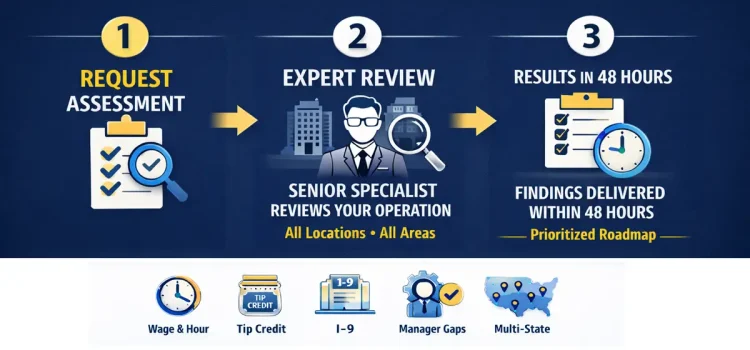
restaurant hr compliance audit process myhrcd

Led by senior HR compliance experts with over 30 years of experience supporting restaurant operators and multi-location restaurant chains.

Conducted by senior HR experts · Findings in 48 hours · No obligation

30+

Years

Exclusive Restaurant HR Experience

500+

Restaurants

Protected Across the U.S.

$20M+

In Potential Fines

Avoided for Our Clients

50+

Restaurant Chains

Served Nationwide

100+

DOL Audits

Successfully Managed

Why HR Compliance Audits Are Critical for Restaurants

Restaurant operators function within one of the most heavily regulated employment environments in the country. Federal, state, and local labor requirements evolve continuously — and without structured oversight, compliance gaps often remain invisible until enforcement begins.

A restaurant HR compliance audit is not a procedural exercise. It is a strategic risk evaluation designed to determine whether payroll practices, employee documentation, workplace policies, and management execution align with current regulatory expectations.

Regulators rarely focus on isolated violations. Instead, they identify patterns — repeated inconsistencies across pay periods, employees, or locations — that signal systemic organizational risk.

Most enforcement actions are triggered not by a single mistake, but by operational trends investigators interpret as evidence of weak compliance governance.

For multi-location restaurant groups managing tipped employees, decentralized leadership, and high workforce turnover, proactive audits are no longer optional — they are a core component of enterprise risk management.

Investigators evaluate whether compliance is embedded operationally — not simply documented.

Restaurants rarely fail audits because of one major violation — most fail due to small compliance gaps repeated across locations.

What Triggers a Restaurant Labor Audit?

Regulatory audits are rarely random.

Most begin when enforcement agencies detect operational patterns that suggest elevated compliance risk.

Investigators do not wait for catastrophic violations — they act when repeated inconsistencies indicate systemic exposure.

Common audit triggers include:

Even well-run restaurant groups can face investigations when compliance infrastructure fails to scale alongside operational growth.

By the time regulators initiate contact, exposure has often been accumulating for months — or years.

Early detection is not simply less costly than reactive correction — it is what prevents enforcement altogether.

Most restaurant operators are audited not because they intended to violate labor laws — but because risk indicators went unnoticed.

Audits rarely begin with regulators searching for violations — they begin when data signals risk.

What Investigators Actually Review During a Compliance Audit

During a labor compliance audit, investigators do not rely solely on written policies — they evaluate whether day-to-day operations reflect regulatory expectations.

Audits are designed to identify patterns that signal organizational risk, not just isolated violations.

Reviews typically focus on:

When deficiencies surface across multiple categories, investigators frequently broaden the audit scope — significantly increasing financial exposure, operational disruption, and legal risk.

What begins as a focused review can quickly evolve into a comprehensive investigation.

Many restaurant operators underestimate audit depth until regulators request documentation they are unprepared to produce.

Review the essential labor compliance rules for restaurants

Regulators evaluate what your organization does — not what your handbook says.

The Financial Impact of Failing a Compliance Audit

These are documented outcomes from restaurant chains that discovered compliance gaps during — or after — an enforcement action instead of a proactive audit:

  • $1.03 million in settlements — Nashville restaurant group, wage theft and tip violations across multiple locations. A proactive audit would have identified the tip pool violations before they accumulated across pay periods.
  • $697,000 in back wages — Chicago restaurant group, tipped employees not receiving minimum wage after tip credit errors compounded over multiple pay periods.
  • $178,000 in DOL penalties — Pittsburgh pizzeria, managers illegally participating in tip pools. The violation was present for years before investigators identified it.
  • $179,000 in back wages — Tennessee restaurant, systematic overtime and tip credit violations that had accumulated across multiple pay periods without leadership awareness.

In every case: the violations were present long before enforcement began, the cost of a proactive audit was a fraction of the enforcement outcome, and the operators had no visibility into their exposure until investigators arrived.

The DOL’s restaurant enforcement program recovers more than $274 million annually — the industry with the highest violation rate in the country.

Most large enforcement actions begin with compliance gaps leadership believed were under control.

These outcomes begin with the same gaps most restaurant chains have today — and don’t know about.

48-hour turnaround · Restaurant chains with 3+ locations · Confidential

Operational Signs Your Restaurant May Already Be Exposed to Compliance Risk

Many restaurant organizations operate with hidden compliance vulnerabilities long before regulators intervene.

These risks rarely originate from a single breakdown — they emerge when operational practices drift away from documented policies.

Warning indicators often include:

If these conditions exist, compliance exposure may already be accumulating beneath daily operations — often without leadership visibility.

Regulators do not evaluate intent. They evaluate patterns.

Most enforcement actions begin with warning signs leadership believed were manageable.

Identifying these signals early allows leadership to correct risk before it escalates into regulatory exposure

Recognizing these warning signs in your chain? A compliance audit identifies exactly where the exposure is — and what to correct first.

Our Restaurant HR Compliance Audit Methodology

Unlike generalized HR vendors, MyHRCD conducts compliance audits built specifically around restaurant operational risk.

Our methodology combines senior-level HR expertise with structured evaluation frameworks designed to detect exposure before it escalates into regulatory enforcement.

Each audit is performed through a multi-layer review that analyzes how your organization actually operates — not how policies appear on paper.

Every audit includes:

What Makes This Audit Different?

Most compliance failures are not caused by missing policies — they occur when operational behavior diverges from documented standards.

Our audits focus on identifying those gaps early, when correction is still strategic rather than reactive.

The cost of prevention is always lower than the cost of enforcement.

After the audit, our restaurant HR compliance consultants manage the correction process directly — across all locations

What a Restaurant HR Compliance Audit Delivers — Specific Deliverables

A MYHRCD restaurant HR compliance audit is not a checklist review. It is a structured analysis of how your organization actually operates — with specific, actionable findings delivered within 48 hours of the audit completion.

Audit deliverables include:

  • Wage & Hour Practice Report: Location-by-location analysis of overtime calculations, timekeeping practices, tip credit application, 80/20 rule compliance, and multi-state wage configuration. Each finding is categorized by severity and assigned a correction timeline.
  • Tip Pool & Tip Credit Assessment: Full evaluation of tip pool eligibility, manager exclusion compliance, written notice documentation per employee, and state-specific configuration across all operating locations.
  • I-9 Documentation Review: Complete audit of I-9 forms across all locations — identifying errors, missing forms, expired documents, and re-verification gaps. Includes a 72-hour NOI readiness assessment.
  • Manager Compliance Gap Analysis: Evaluation of whether managers are applying wage and hour rules, tip credit requirements, and documentation standards consistently — and whether training records support a good-faith defense.
  • Multi-Location Consistency Report: Identification of practices that vary across locations — the primary signal investigators use to assess systemic non-compliance.
  • Prioritized Corrective Action Roadmap: Ranked list of findings by enforcement risk level — with specific correction steps, responsible parties, and recommended timelines for each item.

Timeline:

Initial findings delivered within 48 hours. Full corrective action roadmap delivered within 5 business days. For active DOL investigations or NOIs, expedited same-day response is available.

Executive-Level Visibility Into Your Compliance Risk

Following your audit, leadership gains executive-level visibility into where regulatory exposure exists — and how to correct it before it escalates into enforcement.
The most common vulnerabilities emerge within Wage & Hour compliance, Employee Documentation, and Workplace Policies, — operational pillars that regulators closely evaluate when determining organizational risk.

Your audit deliverables include:

Clarity replaces uncertainty — enabling faster, more confident operational decisions.

Because what leadership cannot see  the regulators eventually will.

Most organizations discover risk during an investigation. Resilient operators identify it first.

Our HR compliance services are designed to mitigate these risks, providing structure, visibility, and ongoing compliance management.

Frequently Asked Questions: Restaurant HR Compliance Audits

A restaurant HR compliance audit from myHRCD covers six core areas: wage and hour practices (overtime calculations, timekeeping, tip credit application, 80/20 rule compliance), tip pooling and tip credit compliance across all states of operation, I-9 and employment documentation review, manager compliance gap analysis, multi-location consistency assessment, and a prioritized corrective action roadmap. Findings are delivered within 48 hours with location-level specificity. The audit evaluates how your organization actually operates — not just what your policies say on paper.

Most DOL compliance audits in restaurants are triggered by employee complaints filed through the Wage and Hour Division’s complaint portal — any current or former employee can file anonymously. Other common triggers include tip credit misapplication detected through payroll data, prior violation history, industry-wide enforcement campaigns targeting food service, and referrals from state labor agencies. Restaurants that have been investigated before are significantly more likely to be re-audited. The DOL’s restaurant enforcement program conducts more than 25,000 food service investigations annually — more than any other industry.

Multi-location restaurant chains should conduct a full compliance audit at minimum annually — and immediately when: expanding into a new state, acquiring new locations, experiencing significant management turnover, receiving a DOL or ICE inquiry, or when federal or state wage laws change. State minimum wage rates, tip credit thresholds, and overtime rules change annually in most states. A compliance structure that was correct in January may have gaps by September without a mid-year review. For chains operating in multiple states, semi-annual audits are recommended.

A proactive compliance audit is conducted by your HR compliance partner — at your direction, on your timeline, with full control over how findings are addressed. Violations identified during a proactive audit can be corrected before regulators are involved — treating them as business decisions rather than legal obligations. A DOL investigation is initiated by the government, follows the DOL’s timeline, and findings cannot be corrected retroactively after the investigation opens. Restaurants that correct violations proactively — with documentation of the correction process — consistently achieve significantly better outcomes if they are subsequently audited than those responding to first-time enforcement findings.

The most frequently identified violations in restaurant HR compliance audits are: tip pool structures that include ineligible participants (managers or supervisors), missing or improperly documented written tip credit notices for tipped employees, overtime calculated on the tipped wage rate rather than the full minimum wage, timekeeping systems that auto-deduct meal breaks employees didn’t take, I-9 forms with errors or missing sections, and inconsistent application of wage rules across locations. In most multi-location restaurant chains, at least three of these violations are active simultaneously — often without leadership awareness.

The myHRCD compliance audit process takes 2-5 business days from initiation to full findings delivery, depending on the number of locations and the complexity of multi-state operations. Initial findings — covering the highest-risk exposure areas — are delivered within 48 hours. The complete corrective action roadmap with location-level recommendations follows within 5 business days. For restaurant groups facing an active DOL inquiry or Notice of Inspection, expedited same-day assessment is available with immediate support for investigator response.

Ready to Know Where Your Restaurant Chain Stands?

Our senior HR compliance specialists conduct a full audit of your wage and hour practices, tip credit structure, I-9 documentation, and manager compliance — across all locations. Findings delivered within 48 hours with a prioritized corrective action roadmap.

No obligation. No sales pitch. Just a clear picture of your current exposure — before investigators get there first.

Or call us directly: +1 (203) 675-6796 English  ·  +1 (757) 652-6662 Español

Restaurant chains with 3–50+ locations  ·  Findings in 48 hours  ·  Senior specialists  ·  Confidential  ·  No obligation