Franchise Overtime · Falsified Records · Carolinas
Restaurant Franchise Overtime Violations: IHOP $95K DOL Case Study
myHRCD · 30+ years restaurant complianceFranchise Case Study · Carolinas6 min read
$95K
Back wages recovered
33
Cooks affected
3
Franchise locations
Does your franchise group have the same overtime and recordkeeping exposures?
Get your free 48-hr audit →Table of Contents
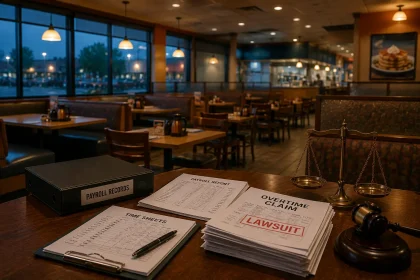
Restaurant franchise overtime violations at three IHOP locations in North and South Carolina cost the operating franchise group $95,095 in back wages for 33 nonexempt cooks — a case that also revealed falsified payroll records designed to obscure the underpaid overtime. The DOL’s Wage and Hour Division investigated three locations operating under separate LLCs and treated them as a single employer based on common control — a finding that every franchise operator running multiple entities under one ownership structure needs to understand.
This case carries two lessons that no other case in this group illustrates: what happens when a franchise operator disguises overtime payments as bonuses, and why the legal structure of your entity does not protect you from a chain-wide DOL investigation.
Case facts — DOL investigation
| Locations | Easley SC · Southern Pines NC · Charlotte NC |
| Back wages recovered | $95,095 |
| Workers affected | 33 nonexempt cooks |
| Violation 1 | Straight-time pay for overtime hours |
| Violation 2 | Overtime payments falsely labeled as bonuses |
| LLC structure | 3 separate LLCs — treated as single group by DOL |
| If willful — potential exposure | ~$190,000 (liquidated damages) |
The LLC Structure Problem: Why Separate Entities Don't Stop a Chain-Wide DOL Investigation
The three IHOP locations in this case operated under separately named LLCs: Foothills Hospitality LLC in Easley, South Carolina; Sandhill Hospitality LLC in Southern Pines, North Carolina; and Highland Hospitality LLC in Charlotte, North Carolina. Each was a distinct legal entity with its own tax identification and payroll structure. The DOL treated all three as a single franchise group based in Westend, North Carolina — because all three operated under the same ownership control.
This is the legal mechanism that most multi-entity franchise operators do not anticipate. The DOL’s joint employer and single employer doctrines allow investigators to consolidate entities under common ownership or control into a single investigation scope. When a violation is found at one LLC, the investigation expands to every entity in the group. Separate legal structures do not create separate compliance universes under federal wage law.
For restaurant franchise operators running three, five, or ten locations under separate LLCs, this means that a complaint at one location generates a records request that covers all locations. The DOL’s look-back calculation runs across the entire group — not just the entity where the complaint originated.
The Two Violations That Built the $95K Case — and Why the Second One Is More Dangerous
Violation 1 — Straight time for overtime hours. The DOL found that 33 nonexempt cooks were paid the same hourly rate for all hours worked — including hours over 40 in a workweek. FLSA requires time-and-a-half for every hour over 40 for nonexempt employees. There is no exemption for cooks, kitchen staff, or any non-supervisory restaurant worker regardless of how they are classified internally. Paying straight time for overtime hours generates retroactive liability for every affected employee for every underpaid pay period within the look-back window.
Violation 2 — Falsified payroll records. Investigators found that the franchise operator maintained payroll records that falsely listed overtime wage payments as bonuses. This recordkeeping violation is more consequential than the overtime error itself for three reasons. First, it obscures the underpayment from any internal audit or compliance review — the error cannot be self-detected when the records hide it. Second, bonuses that are actually wages must be included in the calculation of the regular rate of pay used to determine overtime — when they are excluded, overtime calculations are systematically understated even if the employer later claims to have paid overtime. Third, falsified records are the primary factor that triggers a DOL willfulness determination, which extends the look-back window from two years to three and can result in liquidated damages that double the total liability.
In this case, the DOL did not assess civil money penalties, limiting recovery to $95,095 in back wages. Under a willfulness finding with liquidated damages, the total exposure would have been approximately $190,000 — from the same underlying violations.
Does Your Franchise Group Have These Overtime Exposures?
The restaurant franchise overtime violations found in this case are among the most common payroll configuration errors in multi-location franchise groups. Straight-time payments to nonexempt kitchen staff, bonus classifications used for wage payments, and multi-entity structures that create documentation silos — all three are standard patterns in franchise operations that have not had a dedicated compliance review. Verify how many apply to your group:
⚠ Franchise overtime checklist — verify these in your group
1
Nonexempt employees (cooks, kitchen staff, prep workers) paid straight time for all hours — including hours over 402
Overtime payments labeled as "bonuses" or "incentives" in payroll records instead of OT wages3
Multiple locations operating under separate LLCs — DOL treats them as a single employer if under common control4
Regular rate of pay not recalculated when bonuses are included — overtime base is understated5
No secondary review of payroll records across locations — a falsification at one location goes undetected chain-wideThe DOL's willfulness determination doubles the back-wage liability and extends the look-back to 3 years. Falsified records are the primary factor that triggers a willfulness finding.
Why Restaurant Franchise Overtime Violations Are a Specific Risk Category
Franchise operators face a compliance risk that independent restaurant operators do not: the assumption that the franchisor’s HR or payroll systems cover wage law compliance at the location level. They do not. The franchise agreement governs operations, brand standards, and product specifications — FLSA compliance is the franchisee’s responsibility at every location, regardless of what the franchise disclosure document says about support resources.
The DOL does not contact the franchisor when it investigates a franchisee. It investigates the operator of record at the locations under review. IHOP corporate was not a party to this case — the three franchise operators were. Every restaurant franchise overtime violation finding names the franchisee, not the franchisor, as the responsible employer. The practical implication: a franchise operator running three locations under separate LLCs with payroll administered by a third-party provider has no automatic protection from the violations that provider might be configuring incorrectly across all three entities.
What does this mean for your franchise group?
The DOL treats multiple locations under common control as a single employer. A violation found at one location triggers review of every location in your group — regardless of how they are structured legally.
Find out your franchise group's exposure — free, 48 hoursNo obligation · No sales pressure · Results in 48 hours
How to Prevent Restaurant Franchise Overtime Violations Before the DOL Arrives
Preventing cases like this IHOP franchise investigation requires three verifications that most franchise groups have never performed at the entity-by-entity level:
- Verify nonexempt classification and overtime calculation at every location. Every cook, prep worker, line employee, and non-supervisory kitchen staff member is nonexempt under FLSA. Their overtime must be calculated at time-and-a-half the regular rate for hours over 40. Run the calculation for one pay period at each location and compare the result to what was actually paid.
- Audit your bonus and incentive payment classifications. Any payment that is actually compensation for work — including productivity bonuses, attendance bonuses, and shift differentials — must be included in the regular rate calculation. If your payroll system classifies these payments as bonuses to exclude them from the overtime base, the overtime calculation is wrong for every affected employee in every affected pay period.
- Consolidate compliance review across all entities in your group. The DOL treats commonly controlled entities as a single employer. Your compliance program should do the same — reviewing payroll practices, overtime calculations, and recordkeeping across all locations regardless of their legal structure.
A restaurant compliance audit that covers all locations under your group — regardless of entity structure — is the most reliable way to identify these errors before investigators do. See the complete framework in our wage and hour compliance guide for restaurant chains.
Is Your Franchise Group One Location Investigation Away From a Chain-Wide Review?
Restaurant franchise overtime violations like those in this IHOP case are not the result of negligence — they are the result of payroll configurations that were never verified against FLSA requirements at the location level, compounded by recordkeeping practices that made the error invisible to internal review. Both violations are preventable. Neither is detectable from the outside until an investigator requests three years of payroll records.
myHRCD reviews overtime calculations, bonus classifications, and wage documentation across all locations in your franchise group — regardless of entity structure — and delivers findings within 48 hours. If your franchise group operates under multiple LLCs, that structure needs to be reviewed as a single compliance unit, not location by location. Contact us directly using the information below or schedule a review through our restaurant HR compliance services page.
If your chain has already identified a similar overtime miscalculation internally, the correction window is open before enforcement begins — see restaurant labor violation remediation for the self-correction process.
Already received a DOL contact related to overtime practices? See how myHRCD manages restaurant DOL investigations →
HR
myHRCD Compliance Team
30+ years · Exclusively restaurant chains · 500+ locations protected · $20M+ in fines avoided for clients
Is Your Franchise Group One DOL Investigation Away From a Chain-Wide Review?
myHRCD reviews overtime calculations, payroll recordkeeping, and wage practices across all franchise locations — and delivers findings within 48 hours. No obligation. No sales pressure.
Request your free compliance review →+1 (203) 675-6796 English | +1 (757) 652-6662 Español