30+
Years
Exclusive Restaurant HR Experience
500+
Restaurants
Protected Across the U.S.
$20M+
In Potential Fines
Avoided for Our Clients
50+
Restaurant Chains
Served Nationwide
100+
DOL Audits
Successfully Managed

Restaurant labor compliance rules are governed by a layered system of federal, state, and local requirements that change every year. — and in some markets, mid-year. For multi-location chains, the essential labor compliance rules for restaurants aren’t a single list. They are a matrix of obligations that varies by state, by city, and by employee type. This guide covers the federal baseline requirements under the FLSA ( Fair Labor Standards Act) and the state-specific variations that create the most compliance exposure for restaurant chains in 2026.
The DOL recovered more than $274 million in back wages from food service establishments in 2024 — the most investigated industry in the country. Most of those violations were failures to follow the essential labor compliance rules covered in this guide.
Not sure where your chain stands on these rules?
Senior specialists · 48-hour findings · All compliance areas covered · No obligation
30+
Years
Exclusive Restaurant HR Experience
500+
Restaurants
Protected Across the U.S.
$20M+
In Potential Fines
Avoided for Our Clients
50+
Restaurant Chains
Served Nationwide
100+
DOL Audits
Successfully Managed
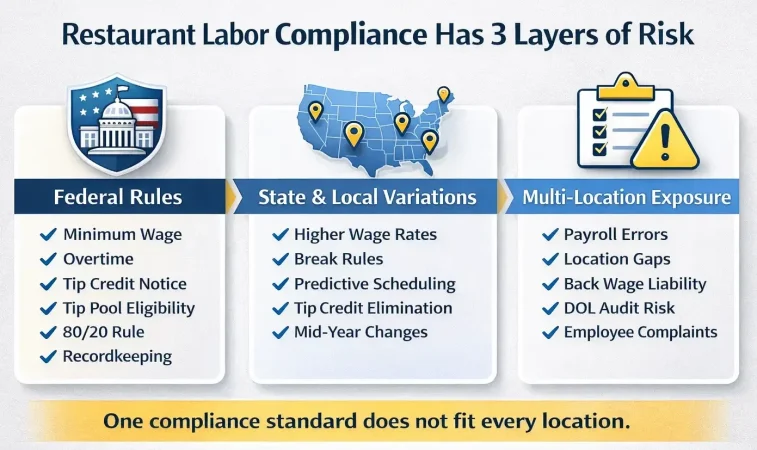
The Fair Labor Standards Act (FLSA) establishes the federal baseline for restaurant labor compliance. Every restaurant in the United States — regardless of size, state, or number of locations — must meet these requirements. State and local laws can only exceed these minimums, never reduce them.
Pay all employees at least the applicable minimum wage — federal ($7.25/hr), state, or local, whichever is highest. For tipped employees, the federal tipped minimum wage is $2.13/hr provided tips bring total compensation to at least $7.25/hr. If tips fall short, the employer must make up the difference — this is not optional. State tipped minimum wages vary significantly. See our complete 2026 restaurant minimum wage by state guide.
Verify current federal rates at the U.S. Department of Labor Wage and Hour Division →
Pay all non-exempt employees at 1.5x their regular rate of pay for all hours worked over 40 in a workweek. For tipped employees, overtime must be calculated at 1.5x the full minimum wage — not 1.5x the tipped cash wage. This is one of the most consistently cited violations in restaurant DOL audits. See our wage and hour compliance for restaurants guide for overtime calculation examples.
Before taking a tip credit, employers must provide each tipped employee with written notice of: the cash wage being paid, the amount of the tip credit claimed, that the tip credit cannot exceed the amount of tips actually received, and that the employee retains all tips unless a valid tip pool is in place. This notice must be provided per employee — a general posting does not satisfy the requirement. Missing written tip credit notices is the most commonly missed requirement in restaurant DOL audits. See our tip pooling compliance for restaurants guide.
Tip pools must include only employees who customarily and regularly receive tips. Managers, supervisors, and owners are expressly prohibited from participating in any tip pool — regardless of whether the employer takes a tip credit. This prohibition has been federal law since the 2018 FLSA (Fair Labor Standards Act) amendments. One ineligible participant in a tip pool can invalidate the entire tip credit retroactively for all pay periods.
The 80/20 dual jobs rule — updated October 2024: The DOL’s 2021 Dual Jobs Rule, which codified a specific 20% threshold, was vacated by a federal court on October 29, 2024. The original dual jobs regulation, which does not impose a specific percentage cap, has been reinstated at the federal level. However, Pennsylvania maintains its own 20% threshold under PA Administrative Code 34-231.101, and New York State enforces a strict 80/20 rule independently. Regardless of the federal rule’s current status, restaurant chains must maintain time-separated records distinguishing tipped from non-tipped duties per shift — the absence of those records creates enforcement exposure in any investigation, and several states require them specifically. Multi-location chains operating in Pennsylvania or New York must apply the applicable state percentage limit at those locations even while the federal rule has no specific cap.
Maintain accurate records of: hours worked each day and workweek, regular hourly rate, total straight-time and overtime earnings, total wages paid each pay period, and any wage deductions. Records must be retained for a minimum of 2 years and produced within a reasonable time if requested by DOL investigators. For tipped employees, records must separately document tipped and non-tipped hours. I-9 employment eligibility records must be retained for 3 years from hire or 1 year after termination, whichever is later. See our I-9 compliance for restaurants guide.
See our complete ICE worksite enforcement guide for restaurant chains in 2026
See how fix restaurant payroll violations before the DOL investigates
Understanding what triggers a DOL Wage and Hour investigation is as important as knowing the rules themselves. Most restaurant operators assume an investigation requires a formal complaint — it doesn’t. The DOL’s restaurant enforcement program operates through five separate trigger mechanisms, each with different warning signs.
Any current or former employee can file a wage complaint anonymously through the DOL’s Wage and Hour Division online portal at no cost. The complaint system is designed to be low-friction — an employee does not need documentation, an attorney, or knowledge of the specific law violated. They describe what happened, the DOL evaluates whether it warrants investigation, and the employer receives no advance notice before investigators begin reviewing records.
Former employees who left under negative circumstances — terminations, disputes over final pay, tip disputes — are the most common complaint filers. Chains with high turnover, recent terminations for cause, or unresolved pay disputes with former employees have elevated complaint risk.
The DOL’s Wage and Hour Division conducts industry-specific enforcement initiatives where investigators proactively target restaurants in a geographic area — regardless of whether any complaint was filed. These campaigns focus on industries with historically high violation rates. The food service industry has been targeted in every enforcement initiative since 2010.
In 2025-2026, the DOL announced a compliance assistance initiative specifically targeting multi-unit restaurant chains with tipped employees — with particular focus on tip credit notice documentation and 80/20 rule compliance. Restaurants in markets with active enforcement campaigns — including the Southeast, Southwest, and Mid-Atlantic regions — are at elevated proactive investigation risk.
Restaurants that have been investigated before are significantly more likely to be re-investigated — especially if the root causes of the original violations were not corrected. The DOL maintains investigation history in its enforcement database. When an investigator opens a case, they review prior enforcement actions at the same employer. A prior investigation with unresolved systemic violations is treated as evidence of willfulness in the current investigation — extending the lookback period from 2 to 3 years and triggering liquidated damages.
Four Washington-based Rancho Chico restaurants were required to pay $750,000 in back wages in June 2026 after investigators found the same minimum wage and overtime violations that had been identified in a prior investigation — with the prior history used to establish willfulness.
The IRS shares payroll data with the DOL’s Wage and Hour Division under a data-sharing agreement. When IRS payroll records show patterns inconsistent with minimum wage compliance — for example, total wages paid to a high number of tipped employees that imply systematic tip credit underpayment — the data can trigger a DOL referral without any employee complaint.
This trigger is particularly relevant for restaurant chains with a high ratio of tipped employees to total payroll — a common characteristic of full-service dining operations.
When ICE conducts an I-9 audit and identifies wage and hour irregularities during document review — for example, tipped employees recorded as receiving less than minimum wage — ICE can refer the matter to the DOL’s Wage and Hour Division for a concurrent investigation. A restaurant that receives an ICE Notice of Inspection is at risk of a simultaneous DOL wage investigation if payroll records reviewed during the ICE audit reveal compliance gaps.
This cross-agency referral mechanism means that an immigration enforcement action can become a multi-agency investigation covering both I-9 documentation and wage and hour compliance simultaneously.
For active ICE Notices of Inspection, the response protocol differs from a DOL wage investigation — see ICE audit restaurant response for the immediate action steps.
If any of these five triggers apply to your operation — a recent employee termination under dispute, a prior DOL investigation, operations in an active enforcement market, or a current ICE audit — the window for self-correction is open now. See restaurant labor violation remediation before enforcement begins →
What to do if DOL investigators have already contacted your restaurant →
For restaurant chains operating in multiple states, the essential restaurant labor compliance rules include a layer of state and local obligations on top of the federal Fair Labor Standards Act baseline. These state rules are the primary source of compliance violations in multi-location chains — not because operators ignore the federal rules, but because state variations are harder to track, change more frequently, and apply differently at each location.
22+ states have minimum wages above the federal $7.25/hr in 2026. Several cities — NYC, Chicago, DC — have rates above their state minimum. The rule is always to pay the highest applicable rate at each location. A chain with locations in Virginia ($12.77/hr), Maryland ($15.80/hr), and DC ($17.95/hr) must maintain three separate payroll configurations. DC eliminated the tip credit entirely in 2023 — any DC tipped employee still being paid at the tipped rate is in violation. See the complete 2026 restaurant minimum wage by state guide.
For the DC-MD-VA corridor: Virginia restaurant compliance 2026 →
For Florida’s September 30 annual update and SB 606: Florida restaurant compliance 2026 →
For the PA-NJ-NY corridor: Pennsylvania restaurant compliance 2026 →
California, Washington, Oregon, Alaska, Minnesota, Montana, Nevada, and DC require employers to pay all employees — including tipped staff — the full state minimum wage. No tip credit is permitted under any circumstances. Chains expanding into these markets must completely restructure their payroll configuration before the first location opens. Applying a tip credit in a no-tip-credit state is a systematic federal violation that generates retroactive liability for every tipped employee in the look-back period.
Restaurant chains operating across Pennsylvania, New Jersey, and New York simultaneously face the same multi-state complexity as the DC-MD-VA corridor — three separate payroll configurations required at every location.
Pennsylvania ($7.25/hr, tipped $2.83/hr) maintains the federal minimum wage floor with the lowest tip credit in the Northeast — but adds a state-specific 80/20 rule under PA Administrative Code 34-231.101 that applies independently of the federal vacatur, and prohibits credit card processing fee deductions from employee tips.
New Jersey ($15.92/hr, tipped $6.05/hr) has the highest minimum wage in the tri-state area, requires make-up calculations on a strict 7-day workweek (biweekly averaging is a violation), and also prohibits processing fee deductions. NJ tip credit phase-out legislation (Assembly Bill A5433) is pending — if passed, would require multi-year payroll restructuring.
New York ($17.00/hr NYC, $16.00/hr upstate, $16.50/hr Long Island/Westchester) adds a further layer — three rates within one state, separate NYC hospitality wage order rates, and a strict 80/20 rule enforced at the state level. NYC operators must apply the hospitality industry wage order rates for food service workers.
A PA-NJ corridor chain that applies Pennsylvania’s $2.83/hr tipped cash wage to New Jersey locations generates minimum wage violations at every NJ location from the first paycheck. See Pennsylvania restaurant compliance 2026 → for the complete PA-NJ-NY corridor analysis.
Federal law does not mandate meal or rest breaks. Many states do. California requires a 30-minute unpaid meal break for shifts over 5 hours and a 10-minute paid rest break for every 4 hours worked — with premium pay for missed breaks. New York requires a 30-minute meal break for shifts over 6 hours. Oregon, Washington, and Illinois have their own break rules. Chains with locations across multiple states must configure break policies per location — a uniform national break policy consistently violates state law in at least one market.
Chicago, New York City, San Francisco, Seattle, Philadelphia, and several other cities require employers to provide advance notice of schedules — typically 14 days — and pay premiums for last-minute changes. These rules apply to restaurant chains above a certain size threshold. Non-compliance generates per-violation penalties that accumulate rapidly in high-volume scheduling operations..
Most states update minimum wage on January 1. Florida updates September 30. Chicago updates July 1. DC updates July 1. Oregon updates July 1. Chains that configure payroll in January and don’t update mid-year are underpaying employees in these markets for the second half of the year — generating back-wage liability for every affected employee per every underpaid pay period.
See our complete Chicago restaurant compliance 2026 guide for the full July 1 checklist
Use this checklist to assess your current labor compliance rules status against the essential labor compliance rules for restaurants. If any item is incomplete or inconsistent across your locations, your chain has active compliance exposure today.
+ 17 additional compliance checks covering tip credit notices, tip pool eligibility, 80/20 rule tracking, I-9 documentation, recordkeeping retention, multi-state configuration, break policies, and predictive scheduling.
Enter your information to receive the full checklist with location-by-location audit tracker, updated for 2026 DOL enforcement priorities.
Already found violations? See self-correction before DOL enforcement begins →
If you have received an ICE Notice of Inspection, see ICE audit restaurant response — what to do immediately →
How many items on this checklist are incomplete at your locations?
+1 (203) 675-6796 English · +1 (757) 652-6662 Español
Knowing the labor compliance rules is the first step. Having every location configured correctly — with the right minimum wage, tip credit structure, break policies, and I-9 documentation — is the compliance function that prevents DOL back-wage assessments and employee lawsuits.
MYHRCD reviews your operation against every essential labor compliance rule for restaurants — at every location, in every state — and delivers findings in 48 hours with a prioritized correction roadmap.
Start with a restaurant HR compliance audit, or work with a dedicated restaurant HR compliance consultant who manages your compliance on an ongoing basis
MYHRCD’s senior specialists review your compliance against every essential labor rule — wage & hour, tip credit, I-9, multi-state payroll. Findings in 48 hours. No obligation.
+1 (203) 675-6796 English · +1 (757) 652-6662 Español
✓ 30+ Years Exclusive Restaurant Experience ✓ 500+ Restaurants Protected ✓ $20M+ Fines Avoided · ✓ Bilingual · ✓ No Obligation
The essential labor compliance rules for restaurants under federal law (Fair Labor Standards Act) are: pay all employees at least the applicable minimum wage — federal, state, or local, whichever is highest; pay overtime at 1.5x the regular rate for all hours over 40 per workweek; for tipped employees, provide written notice before taking a tip credit; limit tip pools to employees who customarily and regularly receive tips — no managers or supervisors; comply with the 80/20 rule for tipped employees performing non-tipped duties; and maintain accurate payroll and timekeeping records for a minimum of 2 years. State and local laws add requirements on top of these federal minimums — including higher minimum wages, mandatory break rules, predictive scheduling requirements, and tip credit elimination in several states.
The most frequently cited restaurant labor law violations in DOL enforcement actions are: overtime calculated at the tipped wage rate instead of the full minimum wage; managers or supervisors participating in tip pools; missing or improperly documented written tip credit notices per employee; auto-deducted meal breaks when employees worked through them; unpaid pre- and post-shift work for setup, breakdown, and mandatory meetings; and applying a single state minimum wage rate to locations in cities with higher local ordinances. Most restaurant chains have at least 3 of these violations active simultaneously — typically without leadership awareness.
Yes — significantly. Federal FLSA sets the minimum floor, but states can and do exceed it. Key variations include: minimum wage rates (22+ states above federal $7.25/hr in 2026); tip credit rules (8 states plus DC have eliminated the tip credit entirely); break requirements (California, New York, Oregon, Washington require paid or unpaid breaks that federal law does not mandate); predictive scheduling (Chicago, NYC, Seattle, SF, Philadelphia require advance schedule notice with premium pay for changes); and overtime thresholds (California requires daily overtime after 8 hours, not just weekly after 40). For multi-location restaurant chains, these variations require separate payroll configurations per location — a uniform national policy consistently violates at least one state’s rules.
The 80/20 rule — formally the “dual jobs” rule — historically limited when an employer could apply the tip credit to time spent on non-tipped duties. The DOL’s 2021 Dual Jobs Rule codified a 20% threshold, but that rule was vacated by a federal court on October 29, 2024, reinstating the original dual jobs regulation which does not impose a specific percentage cap. The practical compliance status in 2026: the 20% threshold no longer has federal regulatory force, but several states maintain their own dual jobs rules with percentage limits — Pennsylvania under PA Administrative Code 34-231.101 and New York State both apply the 20% threshold independently of the federal rule. For all restaurant chains regardless of state, maintaining time-separated records of tipped vs. non-tipped duties per shift remains essential — the absence of those records creates exposure in any investigation. For chains operating in Pennsylvania or New York, the state 20% threshold is a current legal requirement.
Federal FLSA rules change infrequently — the federal minimum wage has not changed since 2009. State and local rules change constantly. Most states update minimum wage on January 1 annually. Florida updates September 30. Chicago and DC update July 1. Oregon updates July 1. States also periodically change break requirements, predictive scheduling rules, and tip credit thresholds. For multi-location restaurant chains, staying current requires monitoring changes in every state and city where locations operate — and updating payroll configurations before each effective date. Missing a mid-year update generates back-wage liability for every affected employee in every underpaid pay period.
Fair Labor Standards ActThe DOL’s Wage and Hour Division investigates restaurants that violate federal FLSA requirements. Violations result in back-wage assessments covering up to 3 years of underpayment for every affected employee. Under DOL Field Assistance Bulletin No. 2025-3 (effective June 27, 2025), WHD no longer seeks liquidated damages in pre-litigation administrative settlements — making early expert-managed resolution significantly less costly than in prior years. However, private class actions filed independently by plaintiff attorneys still carry the full FLSA liquidated damages multiplier under Section 216(b) — effectively doubling the back-wage amount. Civil penalties up to $2,861 per willful violation apply additionally under the 2026 fine schedule. For multi-location chains, a single-location violation that reveals a systematic pattern triggers chain-wide investigation — expanding the scope to all locations for the full look-back period. State violations generate separate state-level penalties on top of federal assessments. The most effective defense is identifying and correcting violations before investigators do — through a proactive restaurant labor compliance review.
Or call directly: +1 (203) 675-6796 English · +1 (757) 652-6662 Español
Senior specialists · 48-hour findings · Restaurant chains 3–50+ locations · No obligation