Tip Credit · Class Action · Nashville, TN
Nashville Restaurant Wage Theft: $1.03M Settlement and What It Means for Your Chain
myHRCD · 30+ years restaurant complianceClass Action Case Study · Nashville, TN7 min read
$1.03M
CLASS ACTION SETTLEMENT
3+
FLSA violations types
3yrs
DOL look-back window
Does your chain have the same tip and wage violations?
Get your free 48-hr-audit →Table of Contents
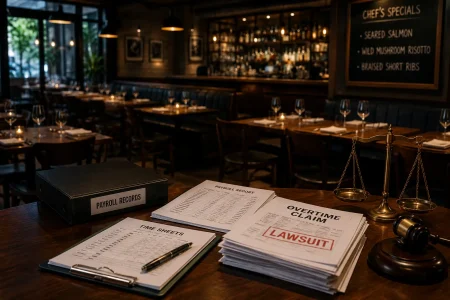
A Nashville restaurant wage theft lawsuit resulted in a $1.03 million settlement after a hospitality and entertainment group was found to have systematically withheld employee tips, diverted tip money to cover business expenses, and required tipped workers to perform excessive non-tipped duties — all violations of the Fair Labor Standards Act. The settlement represents one of the largest recent wage theft payouts in Tennessee’s food service industry and illustrates a pattern that is active in most multi-location restaurant chains right now.
The case consolidated multiple individual complaints into a class action — the mechanism that turns a single employee’s tip grievance into a seven-figure liability for the employer. Understanding how that consolidation happens is the most important compliance lesson this case offers for multi-location operators.
Case facts — class action settlement
| Location | Nashville, Tennessee |
| Settlement amount | $1,030,000 |
| Case type | Multiple class-action lawsuits (consolidated) |
| Primary violations | Tip theft · 80/20 rule · Business expense deductions |
| Largest single violation> | Tips diverted to business expenses + non-tipped staff |
| Additional consequences | Federal oversight · Practice reform obligations |
How a Single Employee Complaint Becomes a $1M Class Action
The defining characteristic of the Nashville case is not the dollar amount — it is the consolidation mechanism. When multiple employees at a restaurant group experience the same FLSA violations, plaintiff attorneys file individual claims and then consolidate them into a single class action covering every affected worker at every location for the entire look-back period. A tip withholding complaint from one server becomes a class covering hundreds of employees across multiple locations over three years.
For multi-location chains, this mechanism is the primary reason why restaurant wage theft lawsuits reach seven figures so quickly. The violations in this Nashville case — tip diversion, 80/20 rule violations, business expense deductions — were not isolated incidents. They were consistent practices applied uniformly across the operation. Plaintiff attorneys specifically look for that uniformity because it is what makes class certification possible.
The DOL’s parallel enforcement mechanism works the same way: a single investigation at one location triggers a chain-wide records request covering all locations under common ownership. Both pathways — civil class action and DOL investigation — activate simultaneously when systematic violations are found.
The Three Violations That Built a $1.03 Million Case
The Nashville settlement was driven by three simultaneous FLSA violations that compounded across multiple pay periods and multiple locations.
Tip diversion to business expenses. The employer deducted tip money to pay for uniforms, operational costs, and non-tipped employee wages. Under FLSA, tips belong exclusively to the employees who earned them — any diversion for business purposes is considered tip theft regardless of how common the practice is in a given market. This violation alone is sufficient to void the tip credit and generate full minimum wage liability for all affected hours.
Tips distributed to non-tipped employees. The employer allowed kitchen staff and support workers to receive money from the tip pool. FLSA permits tip pools only among employees who customarily and regularly receive tips — back-of-house workers do not qualify under the standard tip credit framework. Including them automatically invalidates the pool for all participating employees.
The 80/20 rule violation. Tipped employees were required to spend more than 20% of their shift time performing non-tip-producing duties — cleaning, rolling silverware, prep work, attending meetings. When this threshold is exceeded, the employer cannot take the tip credit for those hours and must pay the full minimum wage. Without time records separating tipped from non-tipped duties, the DOL and plaintiff attorneys assume the tip credit is invalid for all hours, generating full wage liability retroactively for every affected employee across the entire look-back period.
Operating all three violations simultaneously — across multiple locations, across multiple years — is what produced the $1.03 million figure. Each violation multiplies the others: a tip pool that includes non-tipped employees invalidates the tip credit, which means every overtime calculation based on that tip credit is also wrong, which means the back-wage exposure compounds across every affected pay period.
Does Your Chain Have the Same Tip Violations?
The violations in this Nashville restaurant wage theft lawsuit are operating in most multi-location restaurant chains right now — without leadership awareness. The three violations that produced this settlement are among the most common findings in restaurant compliance reviews, and most operators encounter them for the first time when a plaintiff attorney or DOL investigator presents the calculation. Verify how many of these apply to your operation:
⚠ Violation checklist — check what applies to your chain
1
Tips diverted to cover business expenses — uniforms, credit card fees, operational costs2
Kitchen staff, support staff, or back-of-house employees receiving tips from the pool3
Tipped employees spending more than 20% of shifts on non-tipped duties without full wage compensation4
No time records separating tipped duties from non-tipped duties per shift5
No written tip credit notice provided to tipped employees before each pay period6
Managers or supervisors with hiring/firing authority participating in the tip poolIf 2 or more of these apply to your chain, the exposure is likely already accumulating. Class-action attorneys actively search for these patterns in restaurant groups.
Why Restaurant Wage Theft Lawsuits Like This One Are Increasing
Plaintiff law firms have identified the restaurant industry as a high-yield enforcement target. The combination of complex tipped wage rules, high employee turnover, and inconsistent documentation across multi-location operations creates the conditions that make class certification straightforward. When a plaintiff attorney finds a systematic violation, they contact current and former employees across all locations — and the class grows before the employer is aware a lawsuit is being organized.
The DOL’s parallel enforcement record confirms the pattern: more than $274 million recovered from food service establishments in 2024 alone. Restaurant wage theft lawsuits and DOL investigations now run simultaneously in the most significant cases — each feeding the other’s discovery process. A proactive tip credit and tip pooling compliance review identifies the violations that trigger both pathways before either one begins. For a complete overview of the wage rules that apply to your chain, read our guide to wage and hour compliance for restaurant chains ->.
What does this mean for your chain?
Class-action attorneys consolidate individual employee complaints into group claims. A single tip theft complaint at one location can become a $1M class action within months — covering every employee at every location for 3 years.
Find out your chain's exposure — free, 48 hoursNo obligation · No sales pressure · Results in 48 hours
How to Prevent Restaurant Tip Violations Before Attorneys Find Them
Preventing cases like the Nashville settlement requires three operational changes that most chains can implement within 30 days of identifying the gaps:
- Eliminate all tip deductions for business expenses. Credit card processing fees, uniform costs, and any operational expense cannot be deducted from employee tips under FLSA. Review your POS configuration and payroll system for any automatic deductions from tip amounts before distribution.
- Audit your tip pool structure. Only employees who customarily and regularly receive tips can participate in a tip pool — servers, bartenders, bussers in most configurations. Back-of-house workers and any employee with supervisory authority over tipped staff must be excluded. Review the participant list at every location against the FLSA definition.
- Implement 80/20 rule tracking. Create time records that separately document tipped duties and non-tipped duties per shift. The records need to demonstrate that non-tipped work did not exceed 20% of any shift for any tipped employee. Without those records, the DOL’s default assumption is that the threshold was exceeded — and the tip credit is invalid for all hours.
These three changes — applied consistently across all locations — eliminate the primary violations that produced the Nashville settlement. For the complete framework, see our guide to tip pooling and tip credit compliance for restaurant chains and our restaurant HR compliance audit service.
Is Your Restaurant Chain One Complaint Away From a Class Action?
Restaurant wage theft lawsuits like the Nashville settlement are not the result of exceptional misconduct — they are the result of standard operational practices that violate FLSA without operator awareness. The tip diversion, 80/20 violations, and non-tipped employee tip pool participation found in this case are active in most multi-location chains right now.
Every case starts with one complaint. One former employee, one location, one attorney who recognizes the pattern. By the time the class is certified, the look-back calculation already covers every employee at every location for three years. myHRCD reviews your tip credit and tip pooling structure across all locations and delivers findings within 48 hours — before attorneys or investigators do it for you. Contact us directly using the information below.
HR
myHRCD Compliance Team
30+ years · Exclusively restaurant chains · 500+ locations protected · $20M+ in fines avoided for clients
Is Your Chain One Employee Complaint Away From a Class Action?
myHRCD reviews your tip credit structure, tip pool practices, and wage documentation across all locations — and delivers findings within 48 hours. No obligation. No sales pressure.
Request your free compliance review →+1 (203) 675-6796 English | +1 (757) 652-6662 Español