30+
Years
Exclusive Restaurant HR Experience
500+
Restaurants
Protected Across the U.S.
$20M+
In Potential Fines
Avoided for Our Clients
50+
Restaurant Chains
Served Nationwide
100+
DOL Audits
Successfully Managed

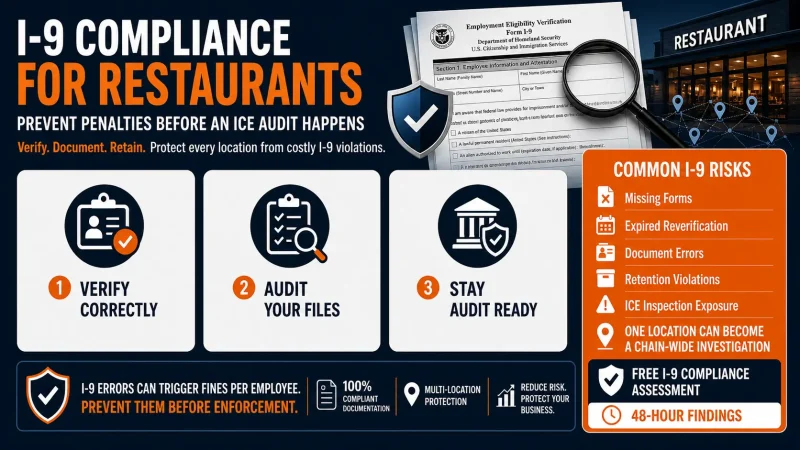
ICE Notices of Inspection arrive without warning. With high turnover, frequent hiring, and decentralized onboarding across locations, restaurant chains are among the most common I-9 audit targets in the country. Proactive I-9 compliance is the only effective defense.
I-9 compliance for restaurants is the most underprepared compliance area in food service — and one of the most aggressively enforced. ICE can issue a Notice of Inspection (NOI) to any employer with 72 hours’ notice, demanding all I-9 records. For a chain with 10 locations and 50 employees per location, incomplete or incorrect I-9 records across 500 employees can result in penalties ranging from $144,000 to $1.43 million based on current 2026 fine schedules.
Most restaurant I-9 violations aren’t intentional. They result from inconsistent onboarding procedures, manager turnover, paper-based systems, and the speed of restaurant hiring. The fix is structural — not a one-time audit.
For restaurant owners and multi-location operators, I-9 and employee documentation compliance is not an administrative task — it is a critical legal and operational risk.
Senior HR specialists · I-9 findings delivered within 48 hours · No obligation
30+
Years
Exclusive Restaurant HR Experience
500+
Restaurants
Protected Across the U.S.
$20M+
In Potential Fines
Avoided for Our Clients
50+
Restaurant Chains
Served Nationwide
100+
DOL Audits
Successfully Managed
Senior HR specialists · I-9 findings delivered within 48 hours · No obligation
Restaurants operate with high employee turnover, frequent hiring, variable schedules, and decentralized onboarding processes — conditions that significantly increase exposure to I-9 and employee documentation compliance violations.
Even minor technical errors — such as missing signatures, incorrect document verification, or incomplete form sections — can result in fines, expanded audit scope, and reputational damage when identified during an ICE inspection, Notice of Inspection (NOI), or Department of Labor investigation.
Over the past decade, immigration enforcement and employment eligibility audits have intensified at both the federal and state levels, with restaurants consistently ranking among the most frequently audited industries due to workforce structure and documentation inconsistencies.
Most violations are not intentional. They stem from unclear procedures, inconsistent onboarding practices across locations, limited manager training, and outdated document storage systems.
Documentation failures are rarely isolated — they compound quietly and escalate into enterprise-level exposure if not addressed proactively.
I-9 audits in the restaurant industry have accelerated significantly over the past three years. ICE’s Form I-9 inspection program — separate from worksite enforcement raids — targets employers systematically across high-turnover industries. Food service consistently ranks in the top three most-audited sectors nationally.
What makes restaurant chains uniquely exposed:
The most expensive I-9 audits aren’t the ones restaurants expect — they’re the ones that expand from a single location complaint into a chain-wide records review covering three years of documentation.
ICE projected more than 12,000 I-9 audits in 2025 — a 10x increase over 2024 — and enforcement has continued to expand in 2026. See ICE worksite enforcement for restaurants 2026 →
Already received a Notice of Inspection? Get immediate ICE audit restaurant response support
Any of these triggers applies to your restaurant? An I-9 compliance review identifies your current exposure before investigators do.
Conducted by senior HR experts · Clear recommendations within 48 hours
Small technical errors — missing signatures, dates, or sections — are among the most frequently cited violations during ICE audits, even when employees are authorized to work
Failure to complete Form I-9 within required timelines often triggers penalties and expanded audit scope during Notices of Inspection.
Accepting unacceptable documents or failing to properly review original identification invalidates employment eligibility verification and exposes restaurants to fines.
Failure to reverify expiring work authorization documents creates ongoing compliance violations that compound over time.
Inability to quickly produce I-9 forms during an ICE inspection significantly weakens audit defense and increases enforcement risk.
Inconsistent retention practices across locations signal systemic non-compliance and often result in enterprise-level enforcement actions.
Most restaurants experience multiple documentation violations simultaneously — often without realizing the cumulative exposure until an ICE audit or Notice of Inspection occurs.
Most restaurant chains have at least 2 of these violations — and don’t know it until the NOI arrives.
48-hour turnaround · Restaurant chains with 3+ locations · 100% Confidential
ICE I-9 fines are adjusted annually for inflation under the Federal Civil Penalties Inflation Adjustment Act. 2026 current ranges — effective January 15, 2026:
For a chain with 5 locations and 50 employees per location — 250 employees total — paperwork violation fines alone can reach $715,250 at the maximum rate ($2,861 × 250 forms). Second-offense unauthorized worker fines for 10 workers reach $143,308.
Know how many of your I-9 records have errors before ICE does. Most chains don’t find out until the fine arrives.
48-hour turnaround · Restaurant chains with 3+ locations · 100% Confidential
On March 16, 2026, ICE updated its Form I-9 Inspection fact sheet — without notice, without rulemaking, without public comment — superseding key provisions of the 1997 Virtue Memorandum that had governed I-9 enforcement for nearly 30 years.
Before March 2026, I-9 violations fell into two categories: technical/procedural violations, which gave employers 10 business days to correct errors before fines were assessed, and substantive violations, which generated immediate monetary fines. The March 2026 fact sheet reclassified dozens of previously correctable technical violations as substantive — meaning many errors that previously had a 10-day correction window now generate immediate fines from the moment ICE reviews the form.
For a restaurant chain producing 250 I-9 forms in response to an NOI, errors that previously generated zero fines if corrected within 10 days may now generate $288–$2,861 per form — with no correction window.
The March 2026 reclassification includes errors that are extremely common in high-turnover restaurant onboarding. Newly substantive violations include: missing List B or C document information in Section 2 when the employer uses a List A document, missing or incorrect translator/preparer certification when assistance was used in Section 1, and Section 2 completed more than 3 business days after the employee’s first day. These errors previously generated no fine if corrected within 10 business days. Under the March 2026 fact sheet, they are subject to immediate penalties.
The March 2026 reclassification makes proactive I-9 review more urgent than at any point since the program began. Errors that were “fixable” under the prior framework are no longer correctable without penalty after ICE reviews the form. For restaurant chains with high-volume onboarding and inconsistent I-9 completion practices, the exposure from paperwork violations has increased significantly — not because the fine amounts changed, but because the correction window for dozens of common errors has been eliminated.
Whether OCAHO — the administrative court that reviews ICE penalty assessments — will hold ICE bound by the prior guidance for forms completed before March 2026 is an open legal question. What is not open: ICE is assessing fines under the new framework for audits initiated after March 16, 2026.
E-Verify is a federal electronic employment eligibility verification system that checks new hire information against DHS and SSA databases. It does not replace the I-9 requirement — it runs alongside it. For restaurant chains, E-Verify creates a second layer of compliance obligations that most operators don’t fully understand until an audit reveals a gap.
E-Verify enrollment is mandatory for restaurant chains in the following circumstances:
Federal contractors and subcontractors — any restaurant group holding a federal contract or operating in a federally-contracted facility must enroll in E-Verify for all new hires nationwide
State-mandated enrollment — the following states require E-Verify for some or all private employers: Arizona (all employers), Mississippi (all employers), North Carolina (employers with 25+ employees), South Carolina (all employers), Utah (employers with 15+ employees), Georgia (employers with 11+ employees), Alabama (all employers), and Tennessee (employers with 50+ employees). Restaurant chains expanding into these states must enroll before hiring the first employee at any new location
Federal government facilities — restaurants operating in federal buildings, military bases, or government-contracted food service operations
An E-Verify audit examines whether the employer used the system correctly — not just whether the I-9 form was completed. ICE and USCIS audit E-Verify participation through the Monitoring and Compliance program, which reviews:
Timely case creation — E-Verify cases must be created within 3 business days of the employee’s first day. Late case creation is a violation even if the employee is authorized to work
Unauthorized pre-screening — using E-Verify to screen applicants before a job offer is extended is prohibited. Restaurants that run E-Verify checks before making an offer are in violation of the program’s terms of participation
Adverse action on tentative non-confirmations — employers cannot terminate or reduce hours for an employee who receives a Tentative Non-Confirmation (TNC) before the resolution process is complete. Premature adverse action is one of the most frequently cited E-Verify violations in restaurant audits
Pattern of non-participation — restaurant chains in mandatory E-Verify states that fail to enroll face separate civil penalties independent of I-9 fines.
If your operation has received an active NOI from ICE, the I-9 response and E-Verify review run concurrently — see ICE audit restaurant response for the immediate action protocol →
The most common misconception among restaurant operators who use E-Verify: that participation protects them from I-9 fines. It does not. A restaurant that runs every new hire through E-Verify but has paperwork errors on the I-9 forms — missing signatures, incorrect document categories, incomplete sections — is still subject to the full range of paperwork violation fines. E-Verify and I-9 compliance are parallel obligations, not alternatives.
myHRCD manages both I-9 documentation and E-Verify compliance as part of the same ongoing engagement — ensuring that both systems are synchronized and audit-ready at every location.
48-hour turnaround · Restaurant chains with 3+ locations · 100% Confidential
During an ICE inspection or Notice of Inspection (NOI), investigators focus on identifying patterns of non-compliance — not isolated mistakes.
Repeated I-9 and documentation issues across employees, locations, or pay periods often result in expanded audit scope, higher penalties, and longer enforcement timelines.
Preparing for an ICE inspection or DOL investigation? or already received a Notice of Inspection?
Immediate support available · English & Spanish
For restaurant chains, I-9 documentation exposure is calculated per violation — not per employee. A paperwork error on a single I-9 form carries a fine of $281 to $2,861. For a chain where 30% of 500 I-9 forms contain errors — a common finding during ICE audits — paperwork fine exposure alone reaches $429,150 at the maximum rate ($2,861 × 150 forms). Add unauthorized worker fines, legal costs, and operational disruption during the investigation period, and cumulative liability for a mid-size chain regularly exceeds seven figures.
In multi-location environments, even small compliance gaps can multiply quickly — turning manageable issues into enterprise-level exposure without proactive oversight.
A Restaurant HR Compliance Audit is the first step in identifying hidden risks and protecting your business from costly labor law violations.
Use this checklist to assess your current I-9 compliance status. If any item is missing or inconsistent across your locations, your chain has audit exposure today.
Restaurant I-9 Compliance Checklist
☐ All current employees have a completed Form I-9 on file
☐ Section 1 completed by employee on or before first day of work
☐ Section 2 completed within 3 business days of start date
☐ Only List A, B, or C documents accepted — no expired documents
+11 additional compliance checks covering document verification, re-verification tracking, record retention, 72-hour production readiness, onboarding consistency, and manager training documentation.
Enter your information to receive the full checklist with location-by-location audit tracker and 2026 ICE enforcement updates.
Missing items on this checklist? Those gaps are fixable before investigators find them.
Already received a Notice of Inspection? Get immediate ICE audit response support →
Most HR firms offer “I-9 support.” MYHRCD manages I-9 compliance as an ongoing function — not a one-time review. For restaurant chains with multiple locations, high turnover, and decentralized onboarding, that distinction is what prevents six-figure ICE penalties.
MYHRCD I-9 compliance management is designed for restaurant chains operating 3 to 50+ locations with tipped employees, frequent hiring, and decentralized onboarding. If you operate one restaurant with 5 employees, you likely don’t need managed I-9 services. If you operate 5+ locations with 30+ employees each, your I-9 exposure is significant — and the cost of managed compliance is a fraction of one ICE fine.
Our HR compliance services help prevent these outcomes by proactively identifying risks and ensuring ongoing compliance across all locations.
The employee must complete Section 1 (personal information and attestation) on or before their first day of work. The employer must complete Section 2 (document verification) within 3 business days of the employee’s first day. For employees hired for 3 days or fewer, Section 2 must be completed by the end of the first day. Missing these timelines is one of the most common I-9 violations in high-turnover restaurant environments — and one of the easiest for ICE to identify during an audit.
I-9 audits in restaurants are most commonly triggered by: employee complaints filed with ICE by current or former staff, industry-wide enforcement campaigns targeting food service, E-Verify discrepancies flagged at any location in your chain, prior NOI history (past-inspected employers are prioritized for re-inspection), media reports or public labor complaints about your operation, and referrals from the DOL’s Wage and Hour Division during concurrent wage investigations. Restaurants are one of ICE’s most frequently targeted industries due to workforce structure and documentation inconsistencies.
No. E-Verify is a separate electronic employment eligibility system that checks employee information against federal databases — it does not replace the I-9 requirement. Employers using E-Verify must still complete Form I-9 for every new hire. Some states (including Arizona, Mississippi, North Carolina, and South Carolina) require certain employers to use E-Verify. Federal contractors are generally required to use it. Completing E-Verify does not protect against I-9 paperwork violation fines for form errors or missing documentation.
An ICE NOI gives you 72 hours to produce all I-9 records. Do not produce records without preparation. Immediately: (1) contact an HR compliance specialist or employment attorney, (2) conduct a rapid internal review to identify obvious errors before submission, (3) document your good-faith compliance efforts to date, and (4) designate a single point of contact for the ICE inspector. Restaurants with organized, complete records and a knowledgeable representative consistently achieve significantly better audit outcomes than those responding without guidance.
Yes — any person you authorize in writing can act as your authorized representative to complete Section 2 at any location. However, the employer — not the representative — bears full legal liability for all errors and omissions. Multi-location restaurant groups should document their authorized representatives for each site, provide standardized I-9 training to all verifiers, and maintain records of that training as part of their audit defense documentation.
I-9 records must be retained for 3 years from the date of hire, OR 1 year after the date employment ends — whichever is later. For a long-term employee hired in 2018 who left in 2025, the I-9 must be retained until 2026. I-9 records should be stored separately from general personnel files — ICE can request I-9s specifically without triggering access to the broader personnel file. Records must be produced within 3 business days of receiving an ICE Notice of Inspection.
2026 ranges effective January 15, 2026: paperwork violations — $288 to $2,861 per form. First offense knowingly hiring unauthorized workers — $716 to $5,724 per worker. Second offense — $5,724 to $14,308 per worker. Third or more offenses — $8,586 to $28,619 per worker. For a mid-size restaurant chain where 30% of 500 I-9 forms contain errors, paperwork fine exposure alone can reach $429,150 at the maximum rate.
Our I-9 compliance specialists review your current documentation practices, identify your highest-risk locations, and deliver a clear findings report within 48 hours. No obligation. No sales pitch. Just the information you need to make a decision.
Senior specialists review your I-9 documentation practices across all locations and deliver findings in 48 hours. No sales call required until you’ve seen the results.
Or call: +1 (203) 675-6796 English · +1 (757) 652-6662 Español
✓ Restaurant chains with 3–50+ locations · ✓ Senior HR specialists, not junior associates · ✓ Results in 48 hours · ✓ Confidential