DOL Enforcement · Wage and Hour · Nationwide
The DOL Has Investigated 25,000+ Restaurants — Is Your Chain Next?
myHRCD · 30+ years restaurant complianceDOL Enforcement Data · Nationwide7 min read
25,000+
Food service investigations since 2016
$274M
Back wages recovered — 2024 alone
195k
Workers received back wages
Is your restaurant chain one of the 25,000+ the DOL has investigated?
Get your free 48-hr audit →Table of Contents
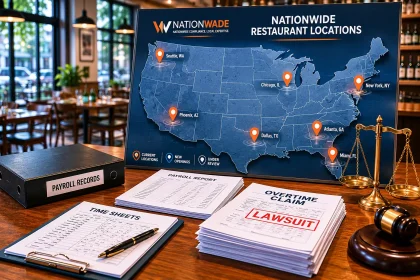
Restaurant DOL investigations of food service establishments have exceeded 25,000 cases since 2016, recovering more than $274 million in back wages for over 195,000 workers — making the restaurant industry the highest-risk sector for federal wage enforcement in the United States. These numbers are not a warning about a distant possibility. They represent an active, ongoing enforcement program that visits restaurants in every state, every month, without prior notice.
For multi-location restaurant chains, the question is not whether the DOL investigates food service. It does, systematically and at scale. The question is what determines whether an investigation finds violations — and how much those violations cost when it does.
DOL Wage and Hour Division — food service enforcement data
| Investigations since 2016 | 25,000+ |
| Back wages recovered (2024) | $274,000,000 |
| Workers who received back wages | 195,000+ |
| Industry enforcement ranking | #1 highest-risk sector nationwide |
| Most common violations found | Tip credit · Overtime · Off-the-clock |
| DOL look-back window | 2 years (3 if willful) |
How the DOL Chooses Which Restaurants to Investigate
The WHD initiates restaurant DOL investigations through four primary channels. The first is employee complaints — a single former employee filing a complaint with the WHD triggers an investigation that covers all locations under common ownership for the full look-back period. The complaint does not need to allege a large amount or name specific violations. It is sufficient to initiate a records request.
The second channel is proactive industry sweeps. WHD regularly selects restaurant groups for investigation without receiving any complaint — based on industry data, prior violation history in a geographic area, and the presence of high-risk payroll structures like tip credit use. A restaurant that has never received a complaint and has no prior DOL history can be selected for a proactive investigation based solely on operating profile.
The third channel is prior violation follow-up. Chains that have settled DOL investigations are placed on monitoring cycles — investigators return within two to three years to verify compliance. The settlement agreement does not protect against a subsequent investigation; it creates a presumption of willfulness if the same violations are found again.
The fourth channel is cross-referral from plaintiff attorneys. Law firms that identify systematic FLSA violations in a restaurant group sometimes refer the case to WHD to initiate parallel federal enforcement alongside the civil lawsuit. In these cases, the employer faces simultaneous DOL investigation and private litigation — both drawing on the same payroll records for the same look-back period.
What DOL Investigators Request First — and Why It Matters for Your Chain
When a WHD investigator initiates a restaurant DOL investigation, the first request is typically for payroll records, timekeeping records, and tip credit documentation for the full look-back period — two years for standard investigations, three years for willful violations. The investigation begins with records, not interviews. What those records show determines the scope and cost of the enforcement action.
For multi-location chains, this means that the investigation is substantially complete before the operator has any opportunity to explain or contextualize the data. If the payroll records show overtime calculated at the tipped wage rate instead of the full minimum wage — as in the Chicago case that cost $697,000 — the back-wage calculation runs automatically across every affected employee at every location for the entire look-back window. If the records show tip pool payments to non-tipped employees — as in the Nashville case that reached $1.03 million — the calculation runs the same way. The dollar amount is a function of the error rate, the number of employees, and the number of pay periods in the look-back window.
The six violations that appear most frequently in food service investigations — based on WHD enforcement data — are listed below. Each one generates retroactive liability across the full look-back period for every affected employee.
⚠ What triggers a DOL investigation in restaurant chains — verify your exposure
1
Employee complaint — even one former employee filing a WHD complaint triggers a full investigation and chain-wide records request2
Industry sweeps — WHD regularly conducts proactive investigations of restaurant chains without receiving any complaint3
Prior violation history — chains previously cited are placed on follow-up review cycles regardless of settlement4
Plaintiff attorney referral — class action attorneys who identify FLSA violations sometimes refer cases to WHD to initiate parallel enforcement5
High-turnover signal — restaurants with unusually high turnover rates appear in WHD's data-driven targeting models6
Competitor investigation expansion — when WHD investigates one chain in a market and finds violations, they often expand to similar operations nearbyThe majority of restaurant DOL investigations are not triggered by egregious misconduct — they are triggered by a single employee complaint or a proactive industry sweep. No size exemption exists.
The 6 Violations Found Most Often in Restaurant DOL Investigations
Based on WHD enforcement reports and the pattern of findings across the food service cases myHRCD has reviewed, these six violations appear in the majority of restaurant investigations:
- Invalid tip pools — including kitchen staff, supervisors, or other non-tipped employees. Any distribution to a disqualified employee voids the tip credit for all participating employees for the affected periods.
- Overtime calculated on the tipped wage rate — the most common calculation error. Overtime must be paid at 1.5x the full minimum wage, not 1.5x the cash tipped wage. The difference compounds across every overtime hour worked by every tipped employee.
- Missing written tip credit notice — FLSA requires written notice before each pay period for every tipped employee. Missing notice invalidates the tip credit for that period regardless of whether the employee was actually paid the full minimum wage.
- Off-the-clock work — setup, breakdown, pre-shift meetings, and uniform time are compensable. Untracked time creates liability that compounds the same way as tip credit errors.
- Recordkeeping failures — incomplete timecards, missing onboarding documentation, and inaccurate payroll records. Recordkeeping failures eliminate the employer’s ability to dispute the WHD’s back-wage calculation.
- Employee misclassification — paying cooks, shift leads, or supervisory-titled employees a salary to avoid overtime liability. FLSA exemption criteria are strict; title and salary alone do not establish exemption.
For the complete wage and hour compliance framework for restaurant chains, including how to verify each of these areas before an investigation begins, see our pillar guide. For tip credit and tip pooling compliance specifically — the source of the majority of food service back-wage findings — see our dedicated guide.
What Determines Whether Your Investigation Costs $95K or $1 Million
The cost of a restaurant DOL investigation food service finding is a mathematical function of four variables: the error rate per pay period, the number of employees affected, the number of pay periods in the look-back window, and whether the violation is found to be willful. The IHOP franchise case that cost $95,095 involved 33 cooks at three locations for a defined look-back period. The Nashville case that cost $1.03 million involved tip violations applied to a larger workforce over a longer period — and was consolidated into a class action that multiplied the liability across every affected employee simultaneously.
A willfulness determination — typically triggered by falsified records, prior violation history, or evidence that management was informed of the violation and continued the practice — extends the look-back from two years to three and subjects the employer to liquidated damages that double the back-wage total. The difference between a non-willful and willful finding can be the difference between $95,000 and $190,000 for the same underlying violations.
The DOL doesn't announce investigations in advance
When investigators arrive, they request 3 years of payroll records for every location under your ownership. The only way to know your exposure is to review it before they do.
Find out your chain's exposure — free, 48 hoursNo obligation · No sales pressure · Results in 48 hours
Is Your Restaurant Chain Prepared for a DOL Investigation?
The 25,000+ restaurant DOL investigations food service establishments have faced since 2016 are not concentrated among bad actors. They are distributed across the full spectrum of the industry — independent restaurants, regional chains, franchise groups, and national operators. The defining characteristic of investigations that result in large back-wage findings is not malicious intent. It is payroll configurations that were never verified against FLSA requirements, applied consistently across multiple locations for multiple years, generating liability that compounds invisibly until investigators calculate it.
myHRCD reviews wage and hour practices, tip credit structure, and payroll documentation across all locations and delivers findings within 48 hours — before the DOL does it for you. Contact us directly using the information below or review our complete restaurant HR compliance services.
HR
myHRCD Compliance Team
30+ years · Exclusively restaurant chains · 500+ locations protected · $20M+ in fines avoided for clients
25,000+ Restaurant Chains Have Already Been Investigated. Is Yours Prepared?
myHRCD reviews tip credit structure, overtime calculations, and wage documentation across all your locations — and delivers findings within 48 hours. No obligation. No sales pressure.
Request your free compliance review →+1 (203) 675-6796 English | +1 (757) 652-6662 Español
Real DOL cases — see what happens when investigators arrive