30+
Years
Exclusive Restaurant HR Experience
500+
Restaurants
Protected Across the U.S.
$20M+
In Potential Fines
Avoided for Our Clients
50+
Restaurant Chains
Served Nationwide
100+
DOL Audits
Successfully Managed

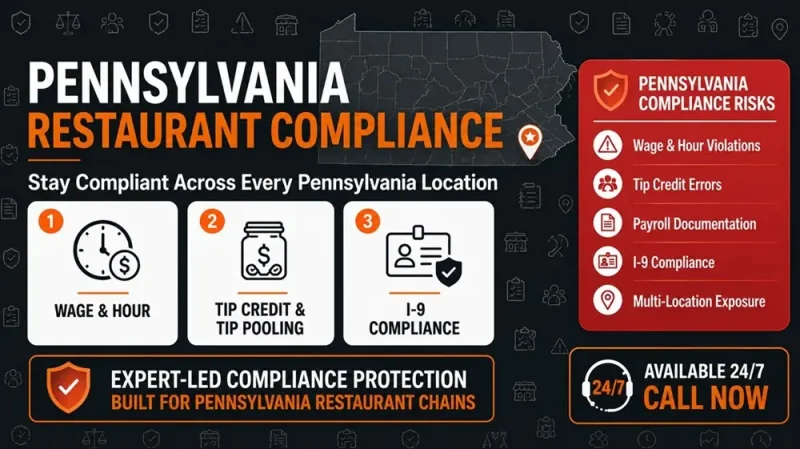
Pennsylvania restaurant compliance in 2026 is governed by the Pennsylvania Minimum Wage Act (43 P.S. § 333.101) and federal FLSA — with one critical difference from most surrounding states: Pennsylvania maintains its own 80/20 rule under state administrative code, independently of the federal rule’s October 2024 vacatur. Restaurant chains operating in Pennsylvania cannot rely on the federal rule’s elimination — Pennsylvania’s own dual jobs percentage limit remains in effect under PA Admin. Code 34-231.101.
Pennsylvania’s minimum wage has not changed since 2009 — $7.25 per hour, the federal floor. The tipped cash wage is $2.83 per hour — higher than the federal $2.13 but lower than every neighboring state except Virginia. The tip credit is $4.42 per hour. For multi-location chains operating across Pennsylvania, New Jersey, and New York simultaneously — the PA-NJ-NY corridor — three separate payroll configurations are required: PA tipped minimum $2.83/hr against $7.25 state minimum, NJ tipped minimum $6.05/hr against $15.92 state minimum, and New York City hospitality rates with a separate tip credit structure.
Pennsylvania restaurant compliance 2026 has three documented DOL enforcement cases that define the violation pattern in the state: The DOL’s Mid-Atlantic region — with district offices in Philadelphia and Pittsburgh — has a documented history of restaurant enforcement in Pennsylvania. La Tolteca Authentic Mexican Restaurant in Wilkes-Barre paid $1.3 million in August 2024 for requiring servers to surrender tips to the restaurant and failing to pay overtime to salaried cooks. Osaka Japan Restaurant in Philadelphia paid $1 million for willful minimum wage and overtime violations affecting 201 employees. Taqueria Moroleon in Avondale paid $193,817 for failing to pay the tipped cash wage and straight-timing all hours.
All three violations are active in most Pennsylvania restaurant chains right now.
Is Your Pennsylvania Restaurant Chain Exposed to the Same Violations as La Tolteca, Osaka, and Taqueria Moroleon?
+1 (203) 675-6796 English · +1 (757) 652-6662 Español
Senior specialists · 48-hour findings · PA-NJ-NY corridor expertise · No obligation
30+
Years
Exclusive Restaurant HR Experience
500+
Restaurants
Protected Across the U.S.
$20M+
In Potential Fines
Avoided for Our Clients
50+
Restaurant Chains
Served Nationwide
100+
DOL Audits
Successfully Managed
If your Chicago payroll wasn’t updated before July 1, back-wage liability is accruing for every affected employee from the first underpaid pay period. myHRCD calculates your exact exposure and corrects it before enforcement begins — findings in 48 hours, documented for non-willful classification.
Pennsylvania’s minimum wage is established under the Pennsylvania Minimum Wage Act of 1968 and has not increased since July 24, 2009 — tied to the federal floor. No increase is currently scheduled.
Pennsylvania’s minimum wage is established under the Pennsylvania Minimum Wage Act of 1968 and has not increased since July 24, 2009 — tied to the federal floor. No increase is currently scheduled.
Standard minimum wage: $7.25 per hour — federal rate, applies to all non-exempt employees including back-of-house kitchen staff, dishwashers, and prep cooks. Pennsylvania is one of 20+ states still at the federal minimum — significantly lower than neighboring New Jersey ($15.92/hr) and New York ($17.00/hr NYC). Restaurant chains expanding from NJ or NY to Pennsylvania must reconfigure payroll to the lower PA rates before the first paycheck — and must retrain managers on the different compliance requirements.
Tipped cash wage: $2.83 per hour — Pennsylvania’s state tipped minimum, which is higher than the federal $2.13/hr. The employer may pay tipped employees $2.83/hr provided total compensation — cash wages plus tips — equals at least $7.25 per hour in every workweek. If tips are insufficient in any workweek, the employer must make up the difference in that same paycheck on a 7-day workweek basis.
Tip credit maximum: $4.42 per hour ($7.25 − $2.83).
Tipped employee threshold: $135 per month in tips — higher than the federal $30/month threshold. Employees who earn less than $135/month in tips do not qualify for the tipped cash wage and must be paid the full $7.25/hr standard rate. Pennsylvania restaurant chains that apply the tipped cash wage to employees who don’t regularly meet the $135/month threshold generate minimum wage violations.
Tipped employee overtime: 1.5x the full Pennsylvania minimum wage, minus the tip credit. Correct rate: $7.25 × 1.5 = $10.875, minus $4.42 = $6.455/hr tipped overtime cash rate. A restaurant paying tipped employee overtime at 1.5x the $2.83 cash wage ($4.245/hr) instead of the correct $6.455/hr is underpaying every overtime hour by $2.21.
No city or county ordinances above state rate: Pennsylvania state law preempts local governments from establishing minimum wages above the state rate. Philadelphia and Pittsburgh cannot legally mandate higher minimum wages for private employers — confirmed by Pennsylvania courts in 2019. Senate Bill 19 (2025) and House Bill 1150 proposed repealing state preemption, but neither was enacted as of February 2026.
Credit card processing fee deductions: Pennsylvania prohibits employers from deducting credit card processing fees from employee tips — regardless of federal FLSA rules that permit proportional deductions. Pennsylvania restaurant chains that deduct any processing fee from tipped employee payouts are in violation of state law.
See the complete restaurant minimum wage by state 2026 guide → for all state rates including the PA-NJ-NY corridor comparison.
Source: Pennsylvania Department of Labor & Industry — Minimum Wage Laws →
Pennsylvania is one of the only states where the 80/20 dual jobs rule remains independently enforceable — regardless of the federal rule’s October 2024 vacatur.
The DOL’s 2021 Dual Jobs Rule, which codified the 20% threshold for non-tipped duties at the federal level, was vacated by a federal court on October 29, 2024. The original federal dual jobs regulation — which does not impose a specific percentage cap — was reinstated. Pennsylvania restaurant operators who assumed this eliminated the 80/20 rule entirely are incorrect.
Under Pennsylvania Administrative Code 34-231.101(b)(2), the employer must establish that the tipped employee primarily performs tipped duties to claim the tip credit. Pennsylvania Department of Labor and Industry guidance consistently applies a 20% threshold — no more than 20% of the 7-day workweek may be spent on non-tipped duties. This state-level requirement was not affected by the federal court’s October 2024 decision.
Restaurant operators in Pennsylvania must maintain time-separated records distinguishing tipped from non-tipped duties per shift — not just because it is best practice, but because Pennsylvania’s own administrative code requires it for tip credit eligibility.
For chains operating in Pennsylvania alongside states where the federal vacatur applies (Virginia, Texas), the compliance requirement differs by state. Pennsylvania employees must have tipped/non-tipped duty time documented separately. The same documentation system that works for Pennsylvania’s state requirement also satisfies whatever the federal rule eventually becomes.
See wage and hour compliance for restaurants → for the full dual jobs analysis and state-by-state status.
Pennsylvania maintains the 80/20 rule independently of the federal vacatur. Is your chain tracking tipped vs. non-tipped duty time per shift at every Pennsylvania location?
+1 (203) 675-6796 English · +1 (757) 652-6662 Español · Immediate availability
The PA-NJ-NY corridor creates the same multi-state payroll complexity as the DC-MD-VA corridor — three jurisdictions, three different minimum wage structures, three separate payroll configurations required.
Federal floor with Pennsylvania’s own 80/20 rule and $135/month tipped threshold. No city preemption. Credit card processing fee deductions from tips prohibited.
New Jersey’s minimum wage is $15.92/hr in 2026 with a tipped cash wage of $6.05/hr and tip credit of $9.87/hr. NJ requires make-up calculations on a strict 7-day workweek — biweekly averaging is a violation. NJ also prohibits credit card processing fee deductions from employee tips. NJ tip credit phase-out legislation (Assembly Bill A5433) has been introduced but not enacted as of 2026.
New York City minimum wage is $17.00/hr with separate hospitality industry wage order rates for food service workers. Upstate New York rate is $16.00/hr. Long Island and Westchester County have a separate rate of $16.50/hr. A PA-NJ-NY corridor chain with locations in Pittsburgh, Philadelphia, Newark, and Manhattan must maintain four distinct payroll configurations within three states.
Applying a single payroll configuration across all three states. A chain that configures tipped employees at Pennsylvania’s $2.83/hr across all corridor locations generates minimum wage violations at every NJ and NY location from the first paycheck. The violation is systematic, it replicates every pay period, and it covers the full lookback period when investigators review records.
See tip pooling compliance for restaurants → for the state-by-state tip credit and pool eligibility rules across the PA-NJ-NY corridor.
The DOL’s Middle District of Pennsylvania obtained a $1.3 million consent judgment against La Tolteca Authentic Mexican Restaurant and owner Carlos De Leon. Investigators found: servers and bartenders required to surrender a percentage of their tips based on total sales to the restaurant, salaried cooks not paid overtime for hours over 40 per workweek, and no records of how tips were used — making it impossible to demonstrate the tip pool was valid.
The outcome determinant: The employer failed to keep records of tip pool contributions and distributions. Without documentation, the employer could not challenge the DOL’s calculation of how much was improperly retained. The absence of records conceded the liability calculation to investigators.
What this means for your chain: If your restaurant requires servers to contribute tips to any pool that benefits the house, or fails to maintain per-employee, per-period tip pool contribution records, the La Tolteca pattern is active in your operation.
Two Philadelphia Osaka restaurants and their owner paid $935,000 in back wages and liquidated damages to 201 employees, plus $65,000 in civil money penalties, for willful minimum wage and overtime violations. The court found the violations willful — triggering the three-year lookback and liquidated damages — and permanently enjoined the employers from future FLSA violations.
The outcome determinant: Willfulness. The same violations that generate back wages only under non-willful classification generated doubled liability under willful. For a 201-employee operation, the difference between non-willful and willful classification was approximately $467,500 in additional liquidated damages exposure.
A federal court ordered Taqueria Moroleon to pay $193,817 to 68 employees after investigators found: no cash wage paid to tipped employees, training and meeting time not compensated, and all hours paid at straight time regardless of overtime hours worked. The court also assessed $47,235 in civil money penalties for recordkeeping failures.
The pattern: Three violations operating simultaneously — the same multi-violation pattern documented in DOL enforcement actions across Pennsylvania, New Jersey, and New York. No single violation in isolation. Each violation compounds the others in the total back-wage assessment.
Already received a DOL contact in Pennsylvania? See how myHRCD manages restaurant DOL investigations →
Every Pennsylvania restaurant chain should verify these items across all Pennsylvania locations. For PA-NJ-NY corridor chains, each item must be verified separately per jurisdiction.
If any item is incomplete, back-wage liability is accruing from the first affected pay period. See restaurant labor violation remediation → for the self-correction process.
See the complete essential labor compliance rules for restaurants for all jurisdictions
A proactive restaurant HR compliance audit → identifies every item on this checklist across all your Pennsylvania and corridor locations in 48 hours.
Pennsylvania restaurant compliance 2026 has three documented DOL cases. All three violations are active in most Pennsylvania restaurant chains right now.
+1 (203) 675-6796 English · +1 (757) 652-6662 Español · Immediate availability
The tipped cash wage in Pennsylvania is $2.83 per hour — Pennsylvania’s state tipped minimum, which is higher than the federal $2.13/hr. The employer may claim a tip credit of up to $4.42 per hour, provided total compensation — cash wages plus tips — equals at least $7.25 per hour in every workweek. To qualify for the tipped cash wage, employees must earn at least $135 per month in tips — higher than the federal $30/month threshold. Make-up payments must be calculated on a 7-day workweek basis.
No. Pennsylvania maintains its own 80/20 rule under PA Administrative Code 34-231.101, independent of the federal rule. The DOL’s 2021 Dual Jobs Rule was vacated by a federal court on October 29, 2024 — reinstating the original federal regulation which has no specific percentage cap. But Pennsylvania’s state administrative code continues to apply a 20% threshold for tipped duty time. Pennsylvania restaurant operators must maintain time-separated records of tipped vs. non-tipped duties per shift regardless of the federal rule’s current status.
No. Pennsylvania state law preempts local governments from establishing minimum wages above the state rate for private employers — confirmed by Pennsylvania courts in 2019. Philadelphia and Pittsburgh cannot legally mandate a higher minimum wage than $7.25/hr for private restaurant operators. Senate Bill 19 (2025) and House Bill 1150 proposed repealing state preemption, but neither was enacted as of February 2026.
No. Pennsylvania prohibits employers from deducting credit card processing fees from employee tips — regardless of federal FLSA rules that permit proportional deductions. Pennsylvania restaurant chains that deduct any processing fee from tipped employee payouts are in violation of state law. For PA-NJ-NY corridor chains, New Jersey also prohibits this deduction — making it a PA-NJ consistent rule that differs from federal law.
The three documented Pennsylvania cases establish the pattern: tip retention by the employer or invalid tip pools (La Tolteca $1.3M), willful minimum wage and overtime violations without records (Osaka $1M), and simultaneous violations of cash wage, overtime, and training time compensation (Taqueria Moroleon $193K). All three involve recordkeeping failures that allowed investigators to set the back-wage calculation without employer challenge. Maintaining complete tip pool records, payroll records, and timekeeping records for the full lookback period is the most effective defense against investigation expansion.
Pennsylvania: $7.25/hr state minimum, $2.83/hr tipped cash wage, $4.42/hr tip credit, 80/20 rule under state code, no processing fee deductions. New Jersey: $15.92/hr state minimum, $6.05/hr tipped cash wage, $9.87/hr tip credit, make-up calculations on strict 7-day workweek only, no processing fee deductions, tip credit phase-out legislation pending. A PA-NJ corridor chain that applies a single payroll configuration generates minimum wage violations at all NJ locations from the first paycheck.
The most common triggers in Pennsylvania are employee complaints filed anonymously through the DOL’s online portal, sector-wide enforcement campaigns by the DOL’s Mid-Atlantic region (Philadelphia and Pittsburgh district offices), and prior investigation history. Pennsylvania restaurants with prior DOL investigations face presumptive willfulness if the same violations are found again — triggering the three-year lookback and doubled liability. See what triggers a DOL investigation → for the complete analysis.
La Tolteca paid $1.3 million. Osaka paid $1 million. Taqueria Moroleon paid $193,817 and $47,235 in civil money penalties. All three cases involved violations that were active for years before investigators arrived — and all three turned on missing or inadequate records. myHRCD identifies and corrects the same violations across all your Pennsylvania locations before the DOL does — findings in 48 hours, documented for non-willful classification.
+1 (203) 675-6796 English · +1 (757) 652-6662 Español
✓ 30+ Years Exclusive Restaurant Experience · ✓ PA-NJ-NY Corridor Specialists · ✓ 48-hour findings · ✓ 100% Confidential · ✓ No obligation