30+
Years
Exclusive Restaurant HR Experience
500+
Restaurants
Protected Across the U.S.
$20M+
In Potential Fines
Avoided for Our Clients
50+
Restaurant Chains
Served Nationwide
100+
DOL Audits
Successfully Managed

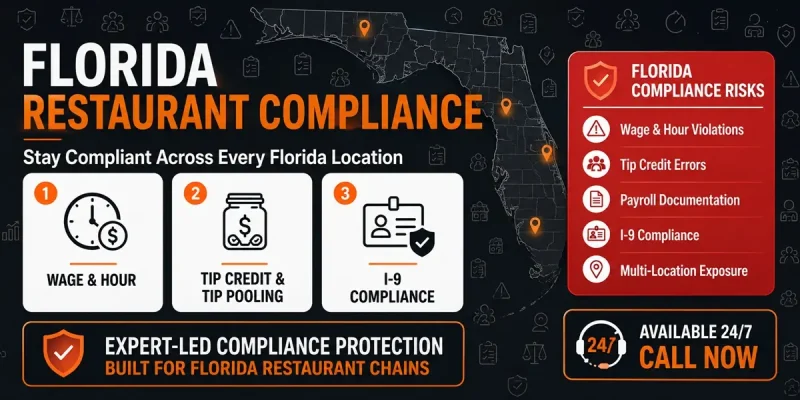
Florida restaurant compliance in 2026 presents two simultaneous deadlines for restaurant operators. Florida’s SB 606 — the service charge disclosure law — took effect July 1, 2026, requiring all food service establishments to disclose mandatory operations charges on menus, websites, ordering apps, bills, and receipts before the customer places their order. And on September 30, 2026, Florida’s minimum wage increases to $15.00 per hour under Amendment 2 — with the tipped cash wage rising from $10.98 to $11.98 per hour and the tip credit remaining at $3.02 per hour.
Missing the September 30 update is the most common Florida restaurant compliance failure. Florida’s annual increase date — September 30 — differs from every other state that updates January 1. Multi-location chains that calendar wage updates for January routinely miss Florida by nine months, generating back-wage liability from October 1 for every tipped and non-tipped employee at every Florida location. After 2026, the update date shifts to January 1 — making the September 30, 2026 update the last time Florida will differ from the national calendar.
If your Florida locations have not implemented SB 606 disclosures or are not prepared for September 30 — or if you are not certain your payroll will be correctly configured before the first post-September 30 pay period — myHRCD calculates your exposure and corrects it before enforcement begins.
September 30 Is Approaching. Is Your Florida Payroll Ready?
+1 (203) 675-6796 English · +1 (757) 652-6662 Español
Senior specialists · 48-hour findings · Available immediately for Florida operators
30+
Years
Exclusive Restaurant HR Experience
500+
Restaurants
Protected Across the U.S.
$20M+
In Potential Fines
Avoided for Our Clients
50+
Restaurant Chains
Served Nationwide
100+
DOL Audits
Successfully Managed
+1 (203) 675-6796 English · +1 (757) 652-6662 Español
Senior specialists · 48-hour findings · Available immediately for Florida operators
Florida operates on a two-rate year. Rates effective September 30, 2025 apply through September 29, 2026. New rates take effect September 30, 2026. Restaurant chains must update payroll configurations before the first pay period that includes September 30 — not after.
Standard minimum wage: $14.00 per hour for all non-exempt employees — kitchen staff, dishwashers, prep cooks, and all back-of-house employees must receive at least $14.00 per hour regardless of any tip arrangements.
Tipped cash wage: $10.98 per hour. The employer may claim a tip credit of $3.02 per hour provided total compensation — cash wages plus tips — equals at least $14.00 per hour in every workweek. If tips are insufficient in any workweek, the employer must make up the difference in that same paycheck.
Tip credit maximum: $3.02 per hour — capped regardless of tip volume.
Tipped employee overtime — the calculation Florida restaurants most often get wrong: 1.5x the full Florida minimum wage, minus the tip credit. Current rate: $14.00 × 1.5 = $21.00, minus $3.02 = $18.98/hr tipped overtime cash rate. A restaurant paying tipped employee overtime at 1.5x the $10.98 cash wage ($16.47/hr) is underpaying every overtime hour by $2.51. For 15 tipped employees working 5 overtime hours per week: $9,412.50 in annual back-wage liability from this single calculation error alone — before liquidated damages double it.
Standard minimum wage: $15.00 per hour — the final step in Amendment 2’s multi-year schedule approved by Florida voters in November 2020. After 2026, annual increases are tied to inflation and take effect January 1.
Tipped cash wage: $11.98 per hour — an increase of $1.00.
Tip credit: $3.02 per hour — unchanged.
Tipped employee overtime from September 30: $15.00 × 1.5 = $22.50, minus $3.02 = $19.48/hr. This overtime recalculation is a separate configuration update from the basic wage rate change and must be verified independently before September 30.
The split pay period problem: A restaurant chain running biweekly payroll with a pay period ending October 12 must apply $14.00/hr to hours worked before September 30 and $15.00/hr to hours worked on and after September 30 within the same pay period. Most payroll software does not do this automatically — it requires a manual configuration update before September 30, not after.
See the complete restaurant minimum wage by state 2026 guide → for all state rates including Florida’s full historical schedule.
Florida restaurant compliance 2026 includes a new service charge disclosure requirement — Florida Senate Bill 606, signed by Governor Ron DeSantis on June 2, 2025, and effective July 1, 2026, requires all Florida food service establishments that charge any mandatory operations fee to disclose that fee clearly and conspicuously before the customer places their order. The Florida Department of Business and Professional Regulation issued an industry advisory on June 26, 2026 confirming enforcement begins July 1.
The law defines an operations charge as any automatic fee — other than a government-imposed tax — that a customer must pay in addition to the cost of food and beverages. The definition expressly includes: automatic gratuities, service charges, delivery fees, and credit card surcharges. If your Florida restaurant adds any of these to a customer bill automatically, SB 606 applies.
On menus: The operations charge must be disclosed where prices are listed — not in a footnote, not on a separate page, not in small print at the bottom. Font size must be no smaller than the menu item descriptions.
On websites and ordering apps: The charge must appear before the customer places the order — not at checkout, not on the confirmation screen.
On receipts and bills: Each receipt must contain separate lines for gratuity, operations charges, and sales tax. The percentage or amount of each charge must be clearly stated. If the operations charge includes an automatic gratuity, it must be separately stated.
The Florida Division of Hotels and Restaurants — not the DOL — oversees SB 606 enforcement. However, a separate and more expensive compliance risk exists for chains that use automatic service charges to fund employee compensation.
Under IRS Revenue Ruling 2012-18, mandatory service charges are wages — not tips. They must be included in the employee’s regular rate of pay for overtime calculations and are subject to full payroll tax treatment. A Florida restaurant chain that collects a 20% automatic service charge, distributes a portion to servers, and calculates server overtime without including the distributed service charge in the regular rate is generating overtime underpayment on every service charge distribution.
Under SB 606, this charge must now be disclosed before the order is placed. If it isn’t disclosed correctly, the employer faces a SB 606 violation. If the distribution to employees is handled incorrectly for payroll purposes, the employer faces a simultaneous DOL wage and hour exposure. These two violations compound each other.
Update all printed menus with operations charge disclosures in the required format and font size. Update restaurant websites and online ordering apps. Update POS receipt templates to show separate lines for gratuity, operations charges, and sales tax. Train staff on what to tell customers who ask about the charges.
See tip pooling compliance for restaurants → for the IRS and DOL treatment of service charges versus tips and how they affect tip credit eligibility.
Are Your Florida Menus, Websites, and Receipts SB 606 Compliant?
myHRCD reviews your Florida SB 606 disclosures, service charge treatment, and September 30 payroll configuration across all locations — findings in 48 hours.
+1 (203) 675-6796 English · +1 (757) 652-6662 Español · Immediate availability
Florida follows federal FLSA tip credit requirements with no state additions. If any condition fails, the tip credit is invalid for every affected employee for every pay period in which the condition was not met — generating full minimum wage back-wage liability at $14.00/hr (current) or $15.00/hr (after September 30).
Each tipped employee must receive individual written notice stating: the current cash wage ($10.98/hr through September 29, $11.98/hr from September 30), the tip credit amount ($3.02/hr), that tips must bring total compensation to at least $14.00/hr ($15.00/hr after September 30) per workweek, and that the employee retains all tips except through a valid tip pool.
The September 30 update triggers a new notice requirement for every tipped employee at every Florida location. An employee who received a valid notice at $10.98/hr does not have a valid notice at $11.98/hr. New notices must be issued before the first paycheck reflecting the new rate — not after.
Verify current Florida minimum wage rates at the U.S. Department of Labor — Florida minimum wage →
Federal FLSA rules apply — managers and supervisors are expressly prohibited. The January 2025 DOL guidance clarifying that eligibility is determined by the FLSA duties test — not job title — applies in Florida as in all states. Back-of-house staff may participate in tip pools only when the employer pays all employees the full minimum wage without claiming any tip credit.
At $14.00/hr current and $15.00/hr from September 30 — not the federal $7.25/hr. Florida’s higher minimum wage means the make-up payment obligation is larger than in federal-floor states. If a server’s cash wage is $10.98/hr and tips only generated $2.00/hr in a slow week, the employer owes $1.02/hr make-up for every hour worked that week — calculated weekly, not averaged over the pay period.
Florida’s Minimum Wage Act adds a state enforcement mechanism on top of federal FLSA: employers found liable for intentional minimum wage violations face a $1,000 fine per violation under Florida law in addition to back wages and liquidated damages.
Florida falls under the DOL’s Southeast region with district offices in Miami, Orlando, and Tampa. Florida restaurant enforcement follows consistent patterns — and the September 30 annual update creates a predictable enforcement cycle: chains that miss the update generate systematic violations that are identifiable to investigators from the first payroll record request.
When a DOL investigator receives a complaint about a Florida restaurant chain, the first records requested are payroll records from the period immediately after September 30 of the most recent year. If those records show employees were paid at the pre-update rate after September 30, the violation is documented on page one of the investigation. The investigator then expands the scope to all locations and the full lookback period.
A chain with 10 Florida locations and 30 tipped employees per location that missed the September 30, 2025 update from $13.00/hr to $14.00/hr by even one pay period generated approximately $27,000 in back-wage liability from that single missed update — before liquidated damages doubled it.
Florida restaurants that include back-of-house staff in tip pools while claiming the tip credit generate the same outcome as the Perry’s $21.15 million Texas case — complete invalidation of the tip credit for the affected period. The tip pool violation is particularly common in Florida’s full-service dining market where operators attempt to incentivize kitchen performance through tip sharing without understanding the FLSA eligibility requirements.
The interaction between SB 606 service charge compliance and wage and hour law is the most complex issue specific to Florida in 2026. Chains that use automatic service charges to fund employee compensation face simultaneous exposure from Division of Hotels and Restaurants enforcement under SB 606 and DOL enforcement if the service charges are not correctly included in overtime calculations.
Already received a DOL contact in Florida? See how myHRCD manages restaurant DOL investigations →
If you have also received an ICE Notice of Inspection: See ICE audit restaurant response →
If any item is incomplete, back-wage liability is accruing from the first affected pay period.
The difference between correcting now and correcting after a DOL investigation begins is the difference between non-willful classification (2-year lookback, back wages only) and willful classification (3-year lookback, double liability). See restaurant labor violation remediation → for the self-correction process before enforcement begins.
A proactive restaurant HR compliance audit → identifies every item on this checklist across all your Florida locations and delivers findings in 48 hours.
See the complete essential labor compliance rules for restaurants for all jurisdictions
+1 (203) 675-6796 English · +1 (757) 652-6662 Español
✓ 30+ Years Exclusive Restaurant Experience ✓ Chicago specialist · Available immediately ✓ No Obligation
The Florida tipped cash wage is $10.98 per hour through September 29, 2026, and increases to $11.98 per hour on September 30, 2026. The tip credit remains $3.02 per hour. Total compensation — cash wages plus tips — must equal at least $14.00 per hour through September 29 and $15.00 per hour from September 30, in every workweek. If tips are insufficient in any workweek, the employer must make up the difference in the same paycheck.
Florida’s minimum wage increases to $15.00 per hour on September 30, 2026 — the final step in Amendment 2’s schedule. The tipped cash wage increases to $11.98/hr. The tip credit ($3.02/hr) does not change. After 2026, Florida’s minimum wage adjusts annually for inflation with changes taking effect January 1 — the update date shifts from September 30 to January 1 starting in 2027.
Effective July 1, 2026, SB 606 requires all Florida food service establishments that charge any automatic fee — including service charges, automatic gratuities, delivery fees, and credit card surcharges — to disclose those charges on menus, websites, ordering apps, bills, and receipts before the customer places their order. Each receipt must show separate lines for gratuity, operations charges, and sales tax. The Florida Division of Hotels and Restaurants oversees enforcement.
No. Florida law preempts local minimum wage ordinances — no city or county in Florida may set a minimum wage above the state rate. All Florida locations apply the same statewide rate. This is a key difference from Illinois, where Chicago has significantly higher rates than the state.
When the minimum wage increases to $15.00/hr on September 30, the tipped employee overtime rate changes automatically. The correct tipped overtime cash rate from September 30 is $15.00 × 1.5 = $22.50, minus the $3.02 tip credit = $19.48/hr. A payroll configuration using the pre-September 30 rate of $18.98/hr will underpay every tipped employee overtime hour worked after September 30 by $1.50. This overtime recalculation must be verified as a separate configuration update from the basic wage rate change.
No. Under IRS Revenue Ruling 2012-18 and Florida wage law, mandatory service charges are wages — not tips. They must be included in the employee’s regular rate of pay for overtime calculation purposes and are subject to full payroll tax treatment. SB 606 now requires these charges to be disclosed before the customer orders. See tip pooling compliance for restaurants → for the complete treatment of service charges versus tips.
The most common triggers in Florida are employee complaints, missed September 30 updates identified through payroll record review, invalid tip pools, and sector-wide enforcement campaigns by the DOL’s Southeast region. See what triggers a DOL investigation → for the complete trigger analysis including the IRS data-sharing mechanism and cross-agency referrals.
If your Florida payroll isn’t updated before September 30, back-wage liability begins accruing for every tipped and non-tipped employee from the first underpaid pay period. If your SB 606 disclosures are not in place, you face simultaneous state enforcement exposure. myHRCD calculates your exact Florida exposure and corrects it before enforcement begins — findings in 48 hours, documented for non-willful classification.
+1 (203) 675-6796 English · +1 (757) 652-6662 Español
✓ 30+ Years Exclusive Restaurant Experience · ✓ Florida specialist · Available immediately · ✓ No Obligation