Wage and Hour · DOL + Class Actions · 2026
Restaurant Wage and Hour Lawsuits: How They Escalate to 7 Figures
myHRCD · 30+ years restaurant complianceDOL + Class Actions - Nationwaide7 min read
$274M
DOL back wages — 2024
2x
FLSA liquidated damages
$1.03M
Largest class action (Nashville)
Is your chain exposed to the violations that trigger these lawsuits?
Get your free 48-hr audit →Table of Contents
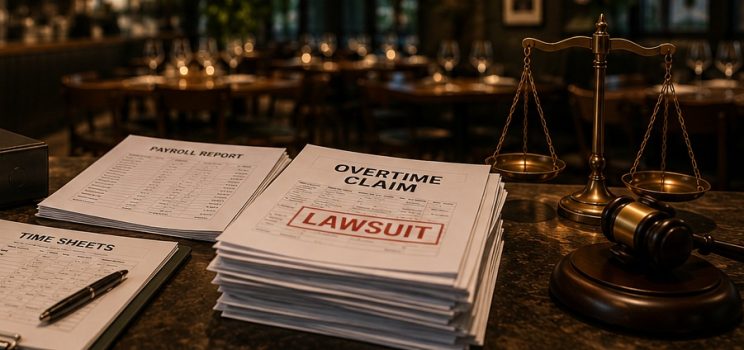
Restaurant wage and hour lawsuits are increasing across the United States — driven by a combination of DOL enforcement actions and private class action litigation that often run simultaneously against the same employer. The food service industry accounts for the largest share of WHD back-wage recoveries: more than $274 million in 2024 alone, across 25,000+ investigations since 2016. The same violations that trigger DOL enforcement — tip credit errors, overtime miscalculations, off-the-clock work — are the primary basis for private wage and hour lawsuits filed by current and former employees.
For multi-location restaurant chains, the distinction between a DOL investigation and a private lawsuit matters less than it appears. Both draw on the same payroll records, both cover the same look-back period, and both can generate seven-figure liability from violations that operators often do not know are active.
Restaurant wage and hour enforcement — 2024 data
| DOL back wages recovered (2024) | $274,000,000 |
| Food service investigations since 2016 | 25,000+ |
| Largest class action settlement (Nashville) | $1,030,000 |
| FLSA liquidated damages | Automatic — doubles back-wage total |
| Look-back window | 2 years (3 if willful) |
How DOL Enforcement and Private Lawsuits Interact
Federal restaurant wage and hour lawsuits and DOL investigations are separate legal mechanisms that increasingly operate in parallel. A WHD investigation begins when an employee files a complaint or when WHD selects an employer for a proactive sweep. A private lawsuit begins when a plaintiff attorney identifies potential class members — typically current or former employees who experienced the same violation — and files on their behalf in federal court under FLSA or applicable state law.
The parallel mechanism activates when plaintiff attorneys refer cases to WHD after identifying systematic violations, or when WHD findings prompt former employees to seek private counsel. In the Nashville case that produced a $1.03 million settlement, individual complaints were consolidated into a class action — a pattern that plaintiff firms actively pursue when they identify uniform violations across multiple locations. The same payroll records that WHD requests in an investigation serve as the evidentiary foundation for the private lawsuit. A restaurant group facing both simultaneously has a single set of records being reviewed by two independent enforcement bodies, each calculating liability independently.
Why Restaurant Wage and Hour Lawsuits Are Concentrated in the Food Service Industry
Three structural characteristics of restaurant operations make the industry the highest-risk sector for wage and hour litigation. First, the tip credit system creates complex compliance obligations — written notice, pool eligibility, 80/20 tracking, and overtime base calculation — that most payroll systems are not configured to handle correctly without restaurant-specific customization. Second, high employee turnover creates a large pool of former employees who may have experienced violations and who plaintiff attorneys can contact through targeted outreach. Third, multi-location operations create the uniformity of violation that makes class certification straightforward — when the same payroll configuration error applies at every location, it creates a class of similarly situated plaintiffs that courts routinely certify.
The result is that restaurant wage and hour lawsuits have become a standard feature of the industry’s legal landscape — not an exceptional event. A compliance program that prevents the underlying violations is the only reliable protection against both enforcement pathways simultaneously. For a complete framework, see our wage and hour compliance guide for restaurant chains and our overview of DOL food service investigations.
⚠ Violations most commonly cited in restaurant wage and hour lawsuits
1
Tip credit errors — invalid pools, missing written notice, or managers in the pool — trigger both DOL investigations and class actions simultaneously2
Overtime miscalculation on tipped wage rate — the most common single violation in food service DOL findings3
Off-the-clock work — setup, breakdown, pre-shift meetings recorded as unpaid time4
80/20 rule violations — no time records separating tipped from non-tipped duties5
Minimum wage shortfalls when tip credit is improperly applied — creates class-wide liability for all tipped employeesClass action attorneys actively recruit restaurant workers with these experiences. A systematic violation found at one location can become a multi-million dollar class action within months.
What Determines Whether a Wage and Hour Violation Becomes a Lawsuit
Not every FLSA violation produces a lawsuit. The violations most likely to generate private litigation share three characteristics: they affect a definable group of similarly situated employees (making class certification viable), they are systematic rather than isolated (making the dollar amount significant enough to justify litigation costs), and they are documentable from payroll records the employer already maintains.
Tip credit violations — invalid pools, missing written notice, overtime calculated on the tipped wage rate — meet all three criteria in most restaurant operations. The Chicago case that cost $697,000 and the IHOP franchise case that cost $95,095 both resulted from violations that were visible in payroll records from the first pay period they occurred. Neither employer knew the violation was active. Both discovered it when investigators requested three years of records.
Is Your Chain Exposed to the Violations That Drive Restaurant Wage and Hour Lawsuits?
Restaurant wage and hour lawsuits are not the result of malicious intent — they are the result of payroll configurations that were never verified against FLSA requirements, applied consistently across enough pay periods to generate significant liability. The violations that produce six- and seven-figure settlements are active in most multi-location restaurant chains right now, without leadership awareness.
myHRCD reviews tip credit structure, overtime calculations, and wage documentation across all your locations and delivers findings within 48 hours — before DOL investigators or plaintiff attorneys review the same records. Contact us using the information below or review our complete restaurant HR compliance services.
DOL investigations and class actions run simultaneously
When a plaintiff attorney identifies systematic violations, they refer the case to WHD for parallel enforcement. Both draw on the same 3 years of payroll records.
Find out your chain's exposure — free, 48 hoursHR
myHRCD Compliance Team
30+ years · Exclusively restaurant chains · 500+ locations protected · $20M+ in fines avoided for clients
Close the Compliance Gaps Before DOL or Plaintiff Attorneys Find Them
myHRCD reviews wage and hour practices, tip credit structure, and payroll documentation across all locations — findings in 48 hours.
Request your free compliance review →+1 (203) 675-6796 English | +1 (757) 652-6662 Español