30+
Years
Exclusive Restaurant HR Experience
500+
Restaurants
Protected Across the U.S.
$20M+
In Potential Fines
Avoided for Our Clients
50+
Restaurant Chains
Served Nationwide
100+
DOL Audits
Successfully Managed

ICE worksite enforcement for restaurants 2026 has reached a historic high — more than 10x the rate of 2024, with funding and data access that gives investigators tools they have never had before. The One Big Beautiful Bill Act — signed July 4, 2025 — allocated over $170 billion for immigration enforcement and funded 10,000 new ICE officers. In the first seven months of the Trump administration, ICE publicly reported at least 40 worksite enforcement actions resulting in over 1,100 arrests — with restaurants, car washes, food processing plants, and construction sites as primary targets. In March 2026, DHS requested access to federal employment records on virtually every worker in the country. Restaurant chains that are not currently prepared for a Notice of Inspection are operating with active exposure.
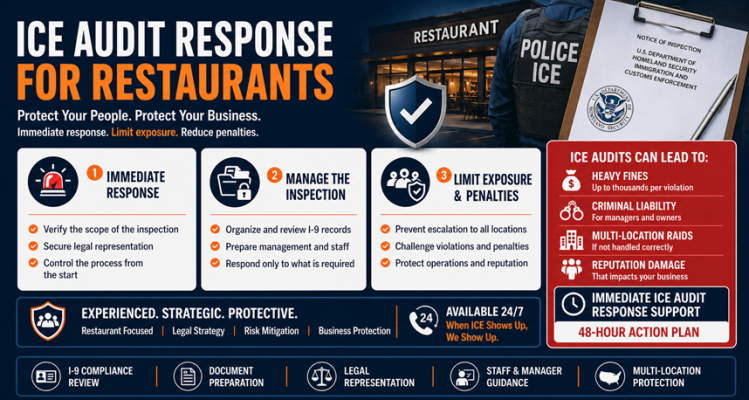
An ICE Notice of Inspection gives restaurant chains 3 business days to produce all Form I-9 records for every current and recent former employee at every location. Chains that are not NOI-ready today will not be NOI-ready when investigators arrive. Preparation takes weeks — not days.
+1 (203) 675-6796 English · +1 (757) 652-6662 Español
Senior specialists · 48-hour findings · Available immediately for active NOI situations
30+
Years
Exclusive Restaurant HR Experience
500+
Restaurants
Protected Across the U.S.
$20M+
In Potential Fines
Avoided for Our Clients
50+
Restaurant Chains
Served Nationwide
100+
DOL Audits
Successfully Managed
Worksite immigration enforcement has occurred under every presidential administration since 1986. What makes 2026 different is not the existence of enforcement — it is the scale, the funding, and the data access that investigators now have.
The One Big Beautiful Bill Act, signed July 4, 2025, allocated over $170 billion for immigration and border enforcement — including funding to hire 10,000 new ICE officers. This funding directly translates to more investigators, more Notices of Inspection, and more worksite operations. ICE’s rate of Notices of Inspection in the first half of 2025 was at least 10 times the rate of 2024, when approximately 230 audits were issued for the entire year. That pace has continued into 2026.
In April 2025, ICE signed a memorandum of understanding allowing access to IRS employer records. In March 2026, DHS requested access to a federal database containing employment records on virtually every worker in the country — ICE requested data on approximately 1.28 million taxpayer records. The practical implication: if your I-9 records don’t match the Social Security information your workers provided to the IRS or DHS employment databases, that discrepancy can now trigger an ICE investigation without a prior complaint or targeted tip. Restaurant chains that have never received a complaint or NOI are no longer protected from proactive targeting — ICE can identify potential violations through data cross-reference before ever contacting an employer.
Previous administrations focused enforcement primarily on undocumented workers. The current approach targets employers directly — using civil fines, criminal referrals, and public enforcement actions as deterrents. For restaurant chain operators, this means the legal and financial exposure is now primarily at the ownership and management level, not at the individual worker level. An employer who cannot produce complete, accurate I-9 records faces civil penalties per violation regardless of the employee’s actual work authorization status.
ICE worksite enforcement for restaurants is disproportionately high for structural reasons — not coincidental ones. Restaurants have high turnover, diverse hiring pools, complex onboarding processes managed at the location level by managers with limited I-9 training, and I-9 records that are frequently incomplete, incorrectly completed, or stored inconsistently across locations. Multi-location chains that process hundreds of I-9s per year across multiple locations without centralized oversight almost always have documentation errors — the only question is whether those errors are found internally or by investigators.
A Notice of Inspection requires an employer to produce all Form I-9 records — not just for the location that received the NOI. For a chain with 10 locations, that means I-9 records for every current and recently terminated employee at all 10 locations, produced within 3 business days. Chains that maintain I-9 records location-by-location without centralized oversight frequently cannot meet that production window without significant disruption. The preparation for that window — organizing, auditing, and remediating records — takes weeks, not days. It must be done before the NOI arrives.
The most common form of ICE worksite enforcement for restaurants. ICE serves a Notice of Inspection requiring the employer to produce all Form I-9 records within 3 business days. This is an administrative action — it does not require a judicial warrant and ICE does not need probable cause to issue one. The NOI covers all locations under common ownership or management. After reviewing the I-9 records, investigators identify technical violations (incorrect forms, missing sections, improper re-verification) and substantive violations (unauthorized workers). Civil penalties for paperwork violations range from $288 to $2,861 per form — adjusted for inflation effective January 2026. Under the March 2026 ICE Fact Sheet update, many previously correctable technical violations now generate immediate fines with no correction window. Substantive violations generate higher penalties and can lead to criminal referrals. See our complete ICE audit restaurant response guide for the full 72-hour process.
Official I-9 requirements and acceptable documents: ICE I-9 Central
ICE agents arrive at a restaurant location without advance notice, typically with a judicial search warrant or arrest warrants for specific individuals. ICE can enter the public areas of a restaurant without any warrant — dining rooms, lobbies, and any area accessible to the public. A judicial search warrant is required to enter private areas — kitchens, offices, storage rooms. An administrative warrant signed by an ICE official does not authorize entry into private areas. Restaurant chain operators should ensure all location managers know the difference between a judicial warrant and an administrative warrant and understand that they are not required to grant entry to private areas without a judicial warrant.
When ICE identifies patterns of knowing employment of unauthorized workers, document fraud, or human trafficking at a restaurant operation, it can initiate a criminal investigation. Criminal investigations typically follow I-9 audits that reveal systemic violations or are triggered by tips from current or former employees. For restaurant chains, the most common criminal exposure is “pattern or practice” of knowingly hiring unauthorized workers — which generates personal criminal liability for ownership and senior management, not just civil penalties for the entity.
Every item on this checklist must be in place before a Notice of Inspection arrives. An NOI gives you 3 business days. None of these items can be completed in 3 days.
Missing items on this checklist mean your chain has active ICE exposure today. Every I-9 error is a potential civil penalty. Every gap in re-verification tracking is a potential substantive violation. myHRCD assesses your chain’s ICE readiness across all locations and delivers findings in 48 hours.
How many items on this checklist are incomplete across your locations?
+1 (203) 675-6796 English · +1 (757) 652-6662 Español · Immediate availability
This section covers the immediate response. For the complete 72-hour NOI process — record production, pre-production audit, and investigator communication — see our ICE audit restaurant response guide.
Ask agents to identify themselves and the purpose of their visit. Determine whether they have a Notice of Inspection (requiring document production), an administrative warrant (signed by an ICE official — does not authorize entry into private areas), or a judicial search warrant (signed by a federal judge — authorizes entry into private areas).
ICE can enter any public area of your restaurant without a warrant — dining rooms, lobbies, and any area accessible to customers. ICE cannot enter private areas — kitchens, offices, storage rooms, employee areas — without a judicial search warrant or your consent. You are not required to grant consent. If agents attempt to enter a private area without a judicial warrant, a manager can state: “I do not consent to your entry into this area.” Do not physically interfere with agents under any circumstances.
Contact your designated compliance point of contact and legal counsel before producing any documents or making any statements. For active NOI situations, myHRCD provides same-day response support: +1 (203) 675-6796 English · +1 (757) 652-6662 Español.
Record the names and badge numbers of all agents present, the time of arrival and departure, any documents presented, any documents requested or seized, and any statements made by agents or managers. This documentation is essential for any subsequent legal proceedings.
Managers and employees are not required to answer questions from ICE agents. The right to remain silent applies. Managers should not make statements about the employment status, documentation, or location of any employee without legal counsel present.
If you have already received a Notice of Inspection, do not wait. The 72-hour window begins when the NOI is served. See our complete ICE audit restaurant response guide or call immediately: +1 (203) 675-6796 EN · +1 (757) 652-6662 ES.
ICE worksite enforcement for restaurants is at a historic high — 10x the rate of 2024, with funding and data access that gives investigators tools they have never had before. The IRS data agreement means ICE can identify potential I-9 discrepancies before ever contacting an employer. Preparation is not optional — it is the only viable response to an enforcement environment where the NOI can arrive at any location, at any time, with a 72-hour production window.
MYHRCD assesses your chain’s ICE readiness across every location — I-9 documentation, re-verification tracking, storage and retrieval capability, and manager training — and delivers findings with a specific remediation roadmap in 48 hours.
Start with a restaurant HR compliance audit or work with a dedicated restaurant HR compliance consultant for ongoing I-9 management
Restaurants are a primary target because structural factors — high turnover, decentralized onboarding, manager-level I-9 completion, and inconsistent record storage across locations — create systematic documentation errors that are identifiable from payroll and IRS data without a prior complaint. In March 2026, DHS requested access to employment records on approximately 1.28 million workers. ICE can now identify I-9 discrepancies from federal databases before contacting an employer. For restaurant chains, this means enforcement can arrive at any location based on data pattern-matching — not just employee complaints or visible red flags. ICE worksite enforcement actions in 2025-2026 have resulted in over 1,100 arrests, with restaurants consistently among the top three most targeted industries alongside car washes and food processing plants.
An ICE Notice of Inspection (NOI) is a formal administrative document requiring an employer to produce all Form I-9 records for current and recently terminated employees within 3 business days. The NOI covers all locations under common ownership or management — not just the location where it was served. A restaurant chain with 10 locations that receives an NOI must produce I-9 records for every current employee and recently terminated employee at all 10 locations within that 72-hour window. ICE does not need a warrant, probable cause, or a prior complaint to issue an NOI. Preparation for the 72-hour production window — organizing, auditing, and remediating I-9 records chain-wide — must be done before the NOI arrives. See our ICE audit restaurant response guide for the complete process.
ICE I-9 audit penalties fall into two categories. Paperwork violations — incorrectly completed forms, missing sections, wrong form version, late completion — generate civil penalties of $288 to $2,861 per form under the 2026 schedule effective January 15, 2026. Under the March 2026 ICE Fact Sheet, many previously correctable technical errors now generate immediate fines with no correction window. Substantive violations — employing workers who are not authorized to work — generate civil penalties of $716 to $5,724 per unauthorized worker for a first offense, $5,724 to $14,308 for a second offense, and $8,586 to $28,619 for third or more offenses. For a restaurant chain with 10 locations and 50 employees per location, a 10% I-9 error rate represents 50 potential paperwork violations — up to $143,050 in civil penalties before any substantive violations are assessed. Criminal penalties apply when DOJ finds a pattern or practice of knowingly employing unauthorized workers.
ICE can enter the public areas of a restaurant — dining rooms, lobbies, and any area accessible to customers — without any warrant. ICE requires a judicial search warrant signed by a federal judge to enter private areas — kitchens, offices, storage rooms, and employee-only areas. An administrative warrant signed by an ICE official does not authorize entry into private areas. Restaurant chain operators should ensure all location managers can identify the difference between a judicial warrant and an administrative warrant and know that they are not required to grant consent to enter private areas without a judicial warrant. Clearly marking private areas with “Employees Only” or “Staff Only” signage establishes the private/public distinction before enforcement agents arrive.
myHRCD assesses restaurant chain I-9 compliance across all locations — reviewing every current employee’s I-9 for technical and substantive errors, identifying re-verification gaps for employees with expiring work authorization, evaluating storage and retrieval capability against the 72-hour NOI production requirement, and reviewing manager training for I-9 completion and enforcement response. Findings are delivered in 48 hours with a prioritized remediation roadmap. For active NOI situations — when an NOI has already been received — myHRCD provides same-day response support, managing I-9 collection and organization across all locations within the 72-hour production window, conducting a pre-production error review, and managing investigator communication. See our ICE audit restaurant response guide for active NOI situations.
MYHRCD’s senior specialists assess your I-9 documentation, re-verification tracking, and chain-wide readiness — findings in 48 hours. For active NOI situations, same-day response available.
+1 (203) 675-6796 — English +1 (757) 652-6662 — Español
✓ 100+ DOL Audits Managed · ✓ Restaurant-Only Specialists · ✓ 30+ Years Experience · ✓ Bilingual · ✓ Confidential