30+
Years
Exclusive Restaurant HR Experience
500+
Restaurants
Protected Across the U.S.
$20M+
In Potential Fines
Avoided for Our Clients
50+
Restaurant Chains
Served Nationwide
100+
DOL Audits
Successfully Managed

Found a labor law violation at your restaurant chain?
Call now: +1 (203) 675-6796 · Same-day response · En Español: +1 (757) 652-6662
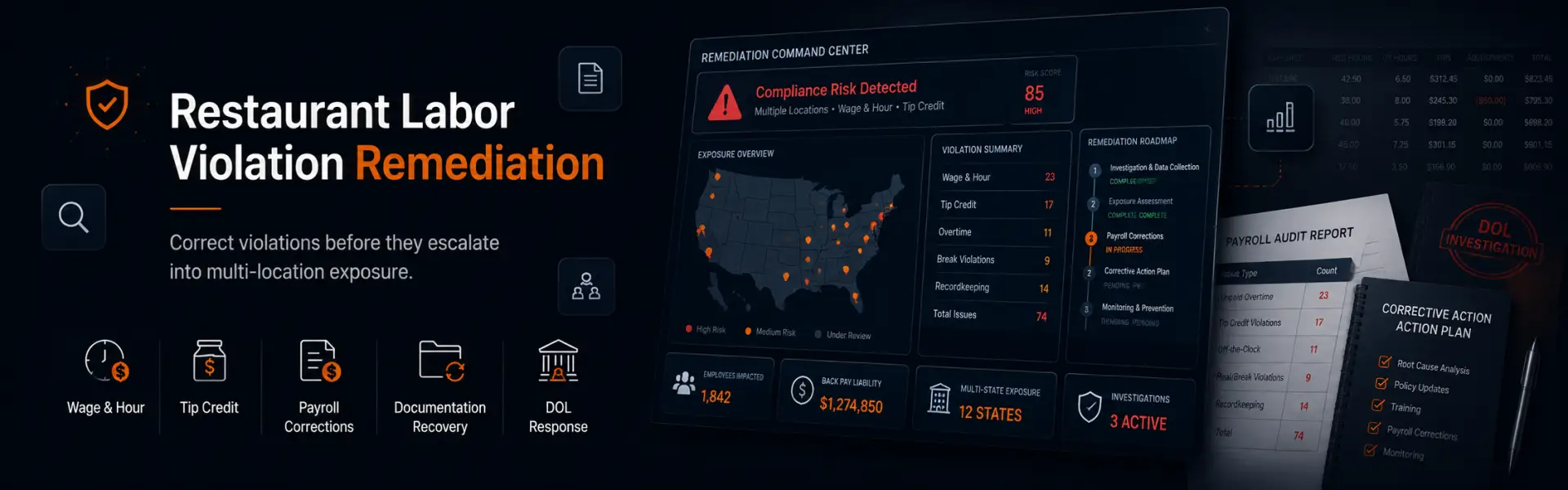
Schedule Free Assessment →Restaurant labor violation remediation is the process restaurant chains use to correct wage, tip credit, or payroll violations internally — before the DOL investigates, before an employee files a complaint, and while the window to act on your own terms is still open.
Most chains that discover a violation wait. They tell themselves it’s a small error, or they’ll fix it quietly. Every day they wait, the retroactive liability grows — and that window shrinks.
myHRCD manages the complete remediation process for restaurant chains with 3–50+ locations. We calculate the exact exposure across every affected location and pay period, build the correction plan, and implement it — with documentation that demonstrates good faith if the DOL ever investigates.
30+
Years
Exclusive Restaurant HR Experience
500+
Restaurants
Protected Across the U.S.
$20M+
In Potential Fines
Avoided for Our Clients
50+
Restaurant Chains
Served Nationwide
100+
DOL Audits
Successfully Managed
+1 (203) 675-6796 English · +1 (757) 652-6662 Español · Available same day — confidential
When a restaurant chain discovers a labor law violation internally, they have something most chains in enforcement never get: control over the timeline.
The DOL’s look-back period is two years for standard violations — and three years if investigators determine the violation was willful. That distinction isn’t about intent. It’s about documentation. Chains that self-correct with a documented remediation plan, produce accurate corrected records, and demonstrate systematic process changes consistently receive non-willful treatment — a 2-year lookback instead of 3. Under DOL Field Assistance Bulletin No. 2025-3 (effective June 27, 2025), WHD no longer seeks liquidated damages during administrative investigations. However, the class action litigation track — where plaintiff attorneys pursue the same violations independently of the DOL — still carries the full liquidated damages multiplier under FLSA Section 216(b). Self-correction documented before any complaint is filed is the only tool that limits exposure on both tracks simultaneously.
Self-correction is not an admission of liability. It is the single most effective tool a restaurant chain has to limit retroactive exposure — and it only works before enforcement begins.
The chains that wait — hoping the error goes unnoticed — are the ones that get the three-year look-back, the liquidated damages multiplier, and the chain-wide expansion. Not because they were worse operators. Because they didn't act when they had the window.
The window to act on your own terms is open right now. Every day it stays open is a day you can correct this without investigators involved.
+1 (203) 675-6796 English · +1 (757) 652-6662 Español · Available same day — confidential
When a restaurant chain discovers a labor law violation, it faces exposure from two separate enforcement tracks that operate independently of each other.
The DOL’s Wage and Hour Division investigates wage and hour complaints and conducts proactive enforcement campaigns. Under Field Assistance Bulletin No. 2025-3 (effective June 27, 2025), WHD no longer seeks liquidated damages during administrative investigations — it pursues back wages only. The look-back period is 2 years for non-willful violations and 3 years for willful violations. A documented self-correction establishes non-willful intent and limits the lookback to 2 years.
Plaintiff attorneys — often working with former employees as serial plaintiffs — file class action lawsuits independently of the DOL. Private class actions carry the full FLSA liquidated damages multiplier under Section 216(b), which doubles the back-wage amount regardless of DOL policy. Attorney fees are paid by the defendant employer. The Perry’s Restaurants $21.15 million judgment was a private class action — not a DOL investigation. For multi-location restaurant chains with systematic violations, private class actions generate larger exposure than DOL administrative enforcement.
A documented self-correction implemented before any employee files a complaint is the only tool that limits exposure on both tracks simultaneously. Once a complaint is filed — to the DOL or directly in federal court — the self-correction window closes.
See how plaintiff attorneys identify and target restaurant chains →
These are the five situations where restaurant operators typically discover a compliance violation before the DOL does — and where the remediation window is still open.
FLSA requirements for restaurants — DOL Wage and Hour Division →
From the moment you engage us, the remediation process runs on a defined timeline — not an open-ended retainer.
1. Tip credit applied in a no-tip-credit state
California, Washington, Oregon, Nevada, Alaska, Minnesota, Montana, DC, Hawaii, and Vermont prohibit the tip credit entirely. Chains that expanded into these markets without reconfiguring payroll have been applying an invalid credit to every tipped employee at every pay period since opening. The retroactive liability is systematic and significant — but entirely correctable before investigators arrive. See our complete tip pooling compliance for restaurants guide →
2. Manager included in a tip pool
One of the most common triggers for DOL enforcement referrals is employee complaints about tip pool distributions. If any manager or supervisor participates in a tip pool — even informally — the entire tip credit is invalidated for the affected pay periods. The correction is operational, not legal, and it's far less costly to implement proactively.
3. Overtime calculated at the tipped rate instead of full minimum wage
Federal law requires overtime to be calculated at 1.5× the full applicable minimum wage — not 1.5× the tipped wage. This error is systematic in most payroll configurations not set up by a restaurant-specific specialist. For a chain with 10 locations and tipped employees working regular overtime, the retroactive exposure can exceed seven figures over a three-year look-back. See how overtime violations accumulate in our wage and hour compliance for restaurants guide →
4. Mid-year minimum wage increase not applied
Florida updates September 30. Chicago updates July 1. DC updates July 1. Oregon updates July 1. Chains that configure payroll in January and don't update mid-year are underpaying tipped employees in these markets for six months of every year. Each missed update is a separate back-wage liability for every affected employee in every underpaid pay period. See current rates for every state in our restaurant minimum wage by state 2026 guide →
5. Off-the-clock work practices
Pre-shift setup, post-shift cleanup, mandatory meetings, and time edits by managers create off-the-clock work violations that accumulate rapidly across high-volume locations. These are among the most common triggers for employee complaints — and the easiest to remediate before those complaints become investigations.
Exposure calculation
48 hours
We calculate the exact retroactive exposure across every affected location and pay period. You receive a documented figure — not an estimate — with methodology that supports a good-faith defense.
Correction plan
Payroll reconfiguration, back-wage calculation by employee, documentation of the correction, and process changes that prevent recurrence. Built for implementation, not a consultant's report.
Implementation & documentation
myHRCD manages implementation across every affected location — payroll changes, corrected records, updated tip pool notices, manager retraining. Every step documented for willfulness defense.
Forward compliance
Ongoing monitoring so the same error doesn't recur as your chain expands, minimum wages update mid-year, or you enter new states.
Employment attorneys are the right resource when you’re in litigation. For self-discovered violations before enforcement begins, a restaurant HR compliance specialist is faster, more cost-effective, and better equipped for the operational side of remediation.
Attorneys calculate legal exposure. myHRCD calculates compliance exposure, builds the correction plan, and implements it — including the payroll reconfigurations, documentation, and process changes that an attorney can’t execute for you.
If the DOL does investigate after your self-correction, myHRCD manages the response. At that point, the documented remediation plan we built is your most valuable asset.
For context on how plaintiff attorneys identify and build class action cases against restaurant chains, see law firms targeting restaurant wage theft
Ready to calculate your exact exposure and start the correction before the DOL does?
+1 (203) 675-6796 English · +1 (757) 652-6662 Español
· Senior specialists · 48-hour findings · Confidential · No obligation
Act immediately. Calculate the exact retroactive exposure across all affected locations and pay periods, build a documented correction plan, and implement it before an employee complaint or DOL investigation begins. A documented self-correction with evidence of systematic process changes consistently results in non-willful classification — a two-year lookback instead of three. Under DOL Field Assistance Bulletin No. 2025-3 (effective June 27, 2025), WHD no longer seeks liquidated damages in administrative investigations. For private class actions filed by plaintiff attorneys — which operate independently of DOL enforcement — liquidated damages still apply under FLSA Section 216(b). A documented self-correction before any complaint is filed limits exposure on both the DOL administrative track and the private litigation track.
The standard FLSA look-back period is two years. If investigators determine the violation was willful — meaning the employer knew or should have known it was illegal — the look-back extends to three years. For a restaurant chain with multiple locations, the difference between two and three years can represent hundreds of thousands of dollars in additional back-wage liability.
Neither. The optimal approach is to calculate the full exposure, implement a documented correction across all affected locations, and maintain that documentation as a good-faith defense. Self-reporting to the DOL before correction is complete is rarely advisable. Waiting and doing nothing exposes the chain to willful classification if the DOL investigates later. myHRCD manages this process — calculating exposure, building the correction plan, and implementing it with full documentation.
The five most common: tip credit applied in a no-tip-credit state, manager included in a tip pool, overtime calculated at the tipped rate instead of full minimum wage, mid-year minimum wage increase not applied, and off-the-clock work practices. All five are correctable before DOL enforcement begins — but the remediation window closes the moment an employee files a complaint.
The free 48-hour assessment identifies the exact scope of the violation, the retroactive liability across all affected locations, and the correction plan.
+1 (203) 675-6796 — English +1 (757) 652-6662 — Español • Available same day
✓ Senior restaurant HR specialist ✓ Findings in 48 hours ✓ 100+ DOL Cases Managed · ✓ $0 penalties in every active investigation · ✓ 30+ Years Experience · ✓ Bilingual · ✓ Confidential